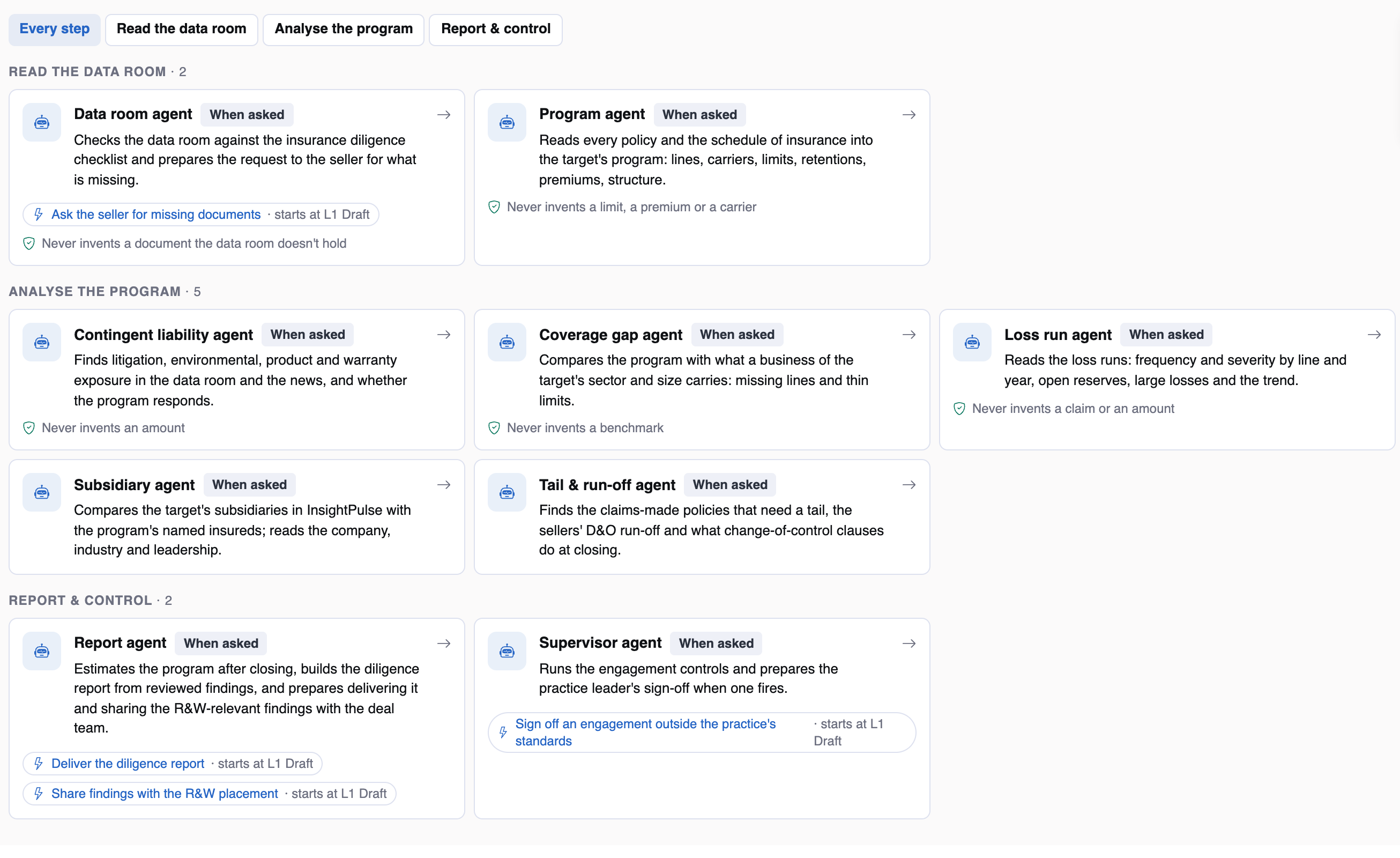
An engagement in InsightDueDiligence reviews one deal target’s insurance program. When someone presses Analyze, nine agents work it in order, each with one job, each grounded in the documents and in InsightPulse, and each stopping where a person has to decide.
The agents are not nine chatbots. Each one works a section of the insurance_program
playbook — 25 questions in 8 sections — with a check that finds what the documents say,
then reasons over those facts with Claude. Figures always come from the engines; the model explains
them, ranks them and says what is still unknown.
The order they run in
What each agent does
| Agent | Works | May prepare | Never invents |
|---|---|---|---|
| Data room | The checklist: policies or a schedule of insurance, five years of loss runs, material contracts, a litigation letter. | The request to the seller for what is missing. | A document the data room doesn’t hold |
| Program | Every policy into the program: lines, carriers, limits, retentions, premiums, terms, triggers, structure, collateral, financing. | — | A limit, a premium or a carrier |
| Coverage gap | The program against the practice’s benchmark for the sector and revenue band: missing lines, thin limits. | — | A benchmark |
| Loss run | Frequency and severity by line and year, open reserves, large losses, the trend. | — | A claim or an amount |
| Tail & run-off | Claims-made policies needing a tail, the sellers’ D&O run-off, change-of-control and assignment clauses. | — | — |
| Subsidiary | InsightPulse’s corporate hierarchy against the named insureds; the company, industry and leadership. | — | — |
| Contingent liability | Litigation, environmental, product and warranty exposure in the data room and the news, and whether the program responds. | — | An amount |
| Report | The program after closing; the report from reviewed findings. | Delivering the report; sharing R&W-relevant findings with InsightDealDesk. | — |
| Supervisor | The engagement controls in the Rules Studio. | The practice leader’s sign-off when a control fires. | — |
Only four actions exist, and all four are capped at L2, ask first, whatever the autonomy dial says: asking the seller for documents, delivering a report, sharing findings with the deal team and signing off an engagement outside the practice’s standards. Those are a broker’s decisions.
Inside one agent step

Every step is written to the run record with the model used, tokens, cost and a Lense trace. On the illustrative book, the tail and run-off agent’s run on a senior care target used 750 input and 565 output tokens on Claude Haiku 5.5 and cost about four hundredths of a cent; the whole book’s agent work is a few cents. Your engagements and documents will differ.
What the person sees
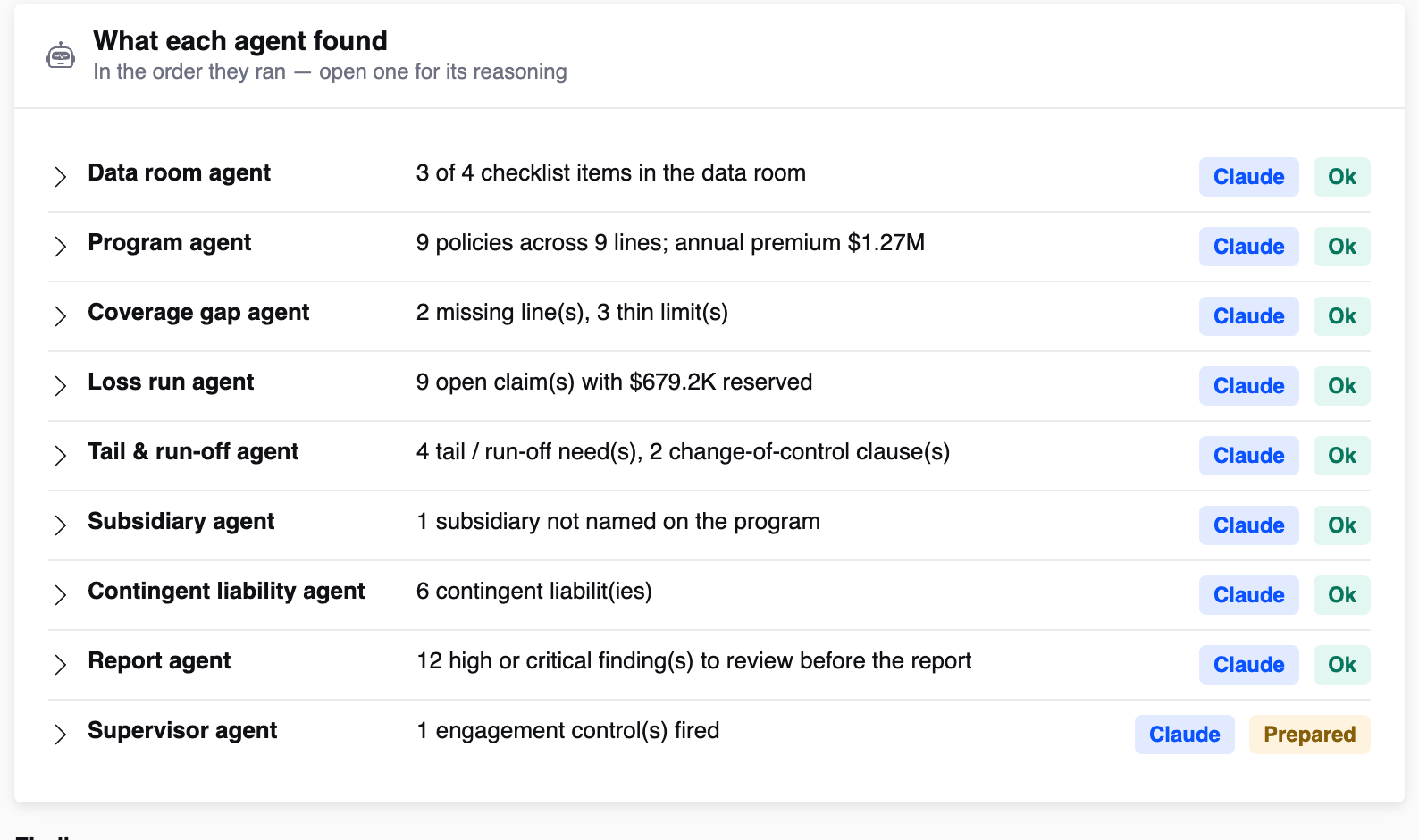
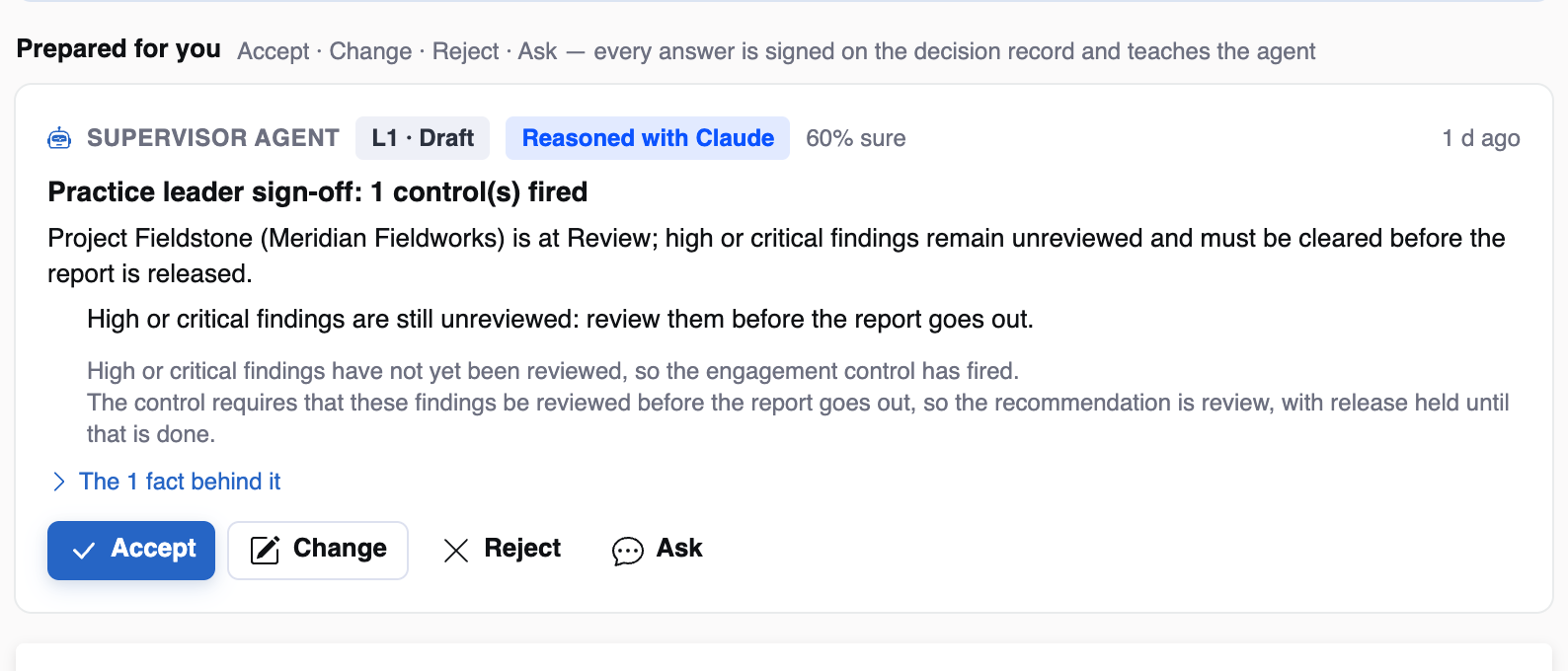
The Findings zone opens with what each agent found, in the order they ran, and the decisions they prepared. Each prepared decision says which agent prepared it, at what level, whether Claude reasoned it, how sure it is and the facts behind it, with four answers: Accept, Change, Reject or Ask. The answer is carried out as the person who gave it, signed on the decision record, and counted as evidence for the agent’s level.
A vendor review uses the same agents
A vendor due diligence review runs the platform’s vendor pack on the same flow. There the data room agent works the whole playbook — SOC 2, sanctions and adverse media, the financial profile, the certificate of insurance, the liability cap — and the program agents stand aside as “not part of this diligence pack”. The report and supervisor agents still run.
When no model is configured
Each agent’s own check findings are the answer, and every prepared decision says it was reasoned by rules. The product works without a model; it is simply less helpful. Nothing pretends a model ran when it did not.
Questions we get asked
Can an agent deliver a report on its own?
No. Delivering a report is capped at L2: the report agent prepares the delivery and a person accepts it.
Why does the supervisor agent exist if the controls are rules?
The controls decide whether something fired. The supervisor agent writes the practice leader’s brief: which control, on what facts, and what the recommendation is, so the sign-off is a decision rather than a rubber stamp.
What does “Run this agent again” do?
Analyze can run a subset of steps. Re-running one agent writes a new step to the run record; earlier steps are never overwritten.

