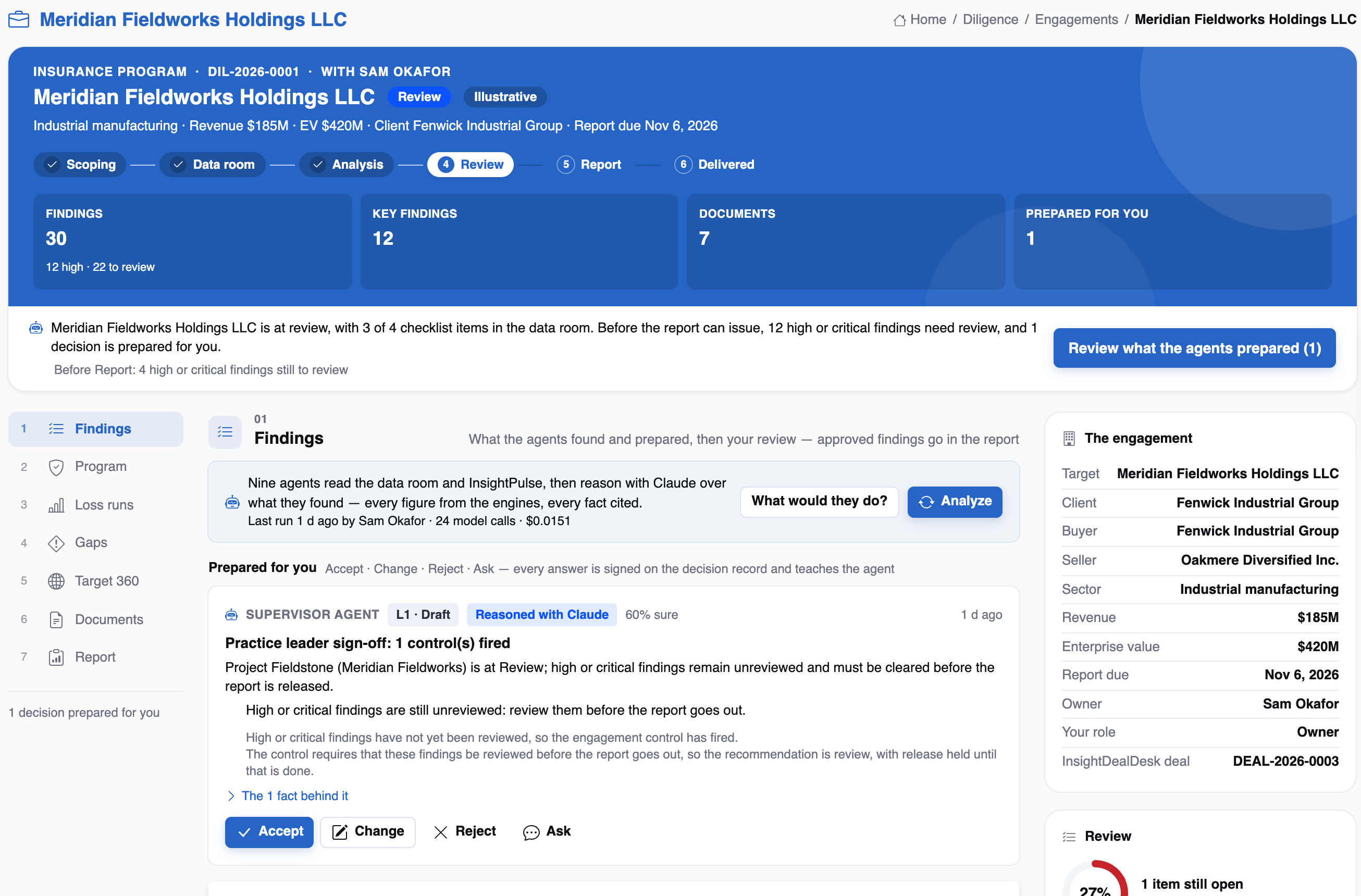
A strategic buyer is acquiring an industrial coatings and fabrication business from a diversified parent. The data room has a schedule of insurance, three policy declarations, five years of loss runs, a Phase I environmental report and a litigation letter from the seller’s counsel. The report is due in nine days. This post follows the engagement from Analyze to the hand-off to the R&W placement. The target, the parties, the carriers and every figure are illustrative.
| Engagement | Project Fieldstone — Meridian Fieldworks Holdings LLC (illustrative), DIL-2026-0001 |
|---|---|
| Deal | Buyout at an illustrative $420M EV; revenue $185M; 940 employees. Buyer Fenwick Industrial Group, seller Oakmere Diversified Inc. (both illustrative) |
| Actors | Deal broker (owner), practice leader (reviewer), analyst (contributor) |
| Data room | Schedule of insurance, D&O, EPL and cyber declarations, loss runs 2022–2026, Phase I (Dayton facility), litigation letter |
| Agents involved | All nine: data room, program, coverage gap, loss run, tail & run-off, subsidiary, contingent liability, report, supervisor |
| Decisions and authority | Every finding reviewed by the deal broker; the practice leader signs off when a control fires; sharing with the deal is a broker’s action |
| Systems touched | InsightPulse (corporate hierarchy, industry, leadership, news), InsightDealDesk (the R&W placement on the same deal) |
| Outcome | 30 findings, 12 high; a program after closing of about $1.54M against $1.27M today plus $315K of tails; six reviewed findings ready for the R&W placement |
Why this target is hard
Three things make an industrial carve-out from a parent program hard to diligence by hand. Four of its nine lines sit on the parent’s master program and end at closing. Its exposures — a groundwater finding and a product suit — live in a Phase I and a legal letter, not in the loss runs. And its corporate structure includes an entity in Mexico that nobody wrote on the named-insured schedule.
D&O end at closing"] C["Phase I: TCE above
screening levels"] --> D["No pollution policy
in the program"] E["Litigation letter:
$2.4M product demand"] --> F["Which policy responds?"] G["Mexican subsidiary
in the hierarchy"] --> H["Not a named insured"] B --> X["Closing surprises"] D --> X F --> X H --> X style X fill:#fdecec,stroke:#e57373
The engagement, step by step
The engagement is created against the client, with the target’s domain as its InsightPulse lookup key and the InsightDealDesk deal it supports (DEAL-2026-0003). The stage strip starts at Scoping.
Seven documents are read into page-level pieces: the schedule into four policy blocks per page, the loss runs into one row per claim, the Phase I and the letter into findings with their severity.
3 of 4 checklist items are in the data room. Material contracts are missing; that is optional in the playbook, so it becomes a low finding and an item on the seller request.
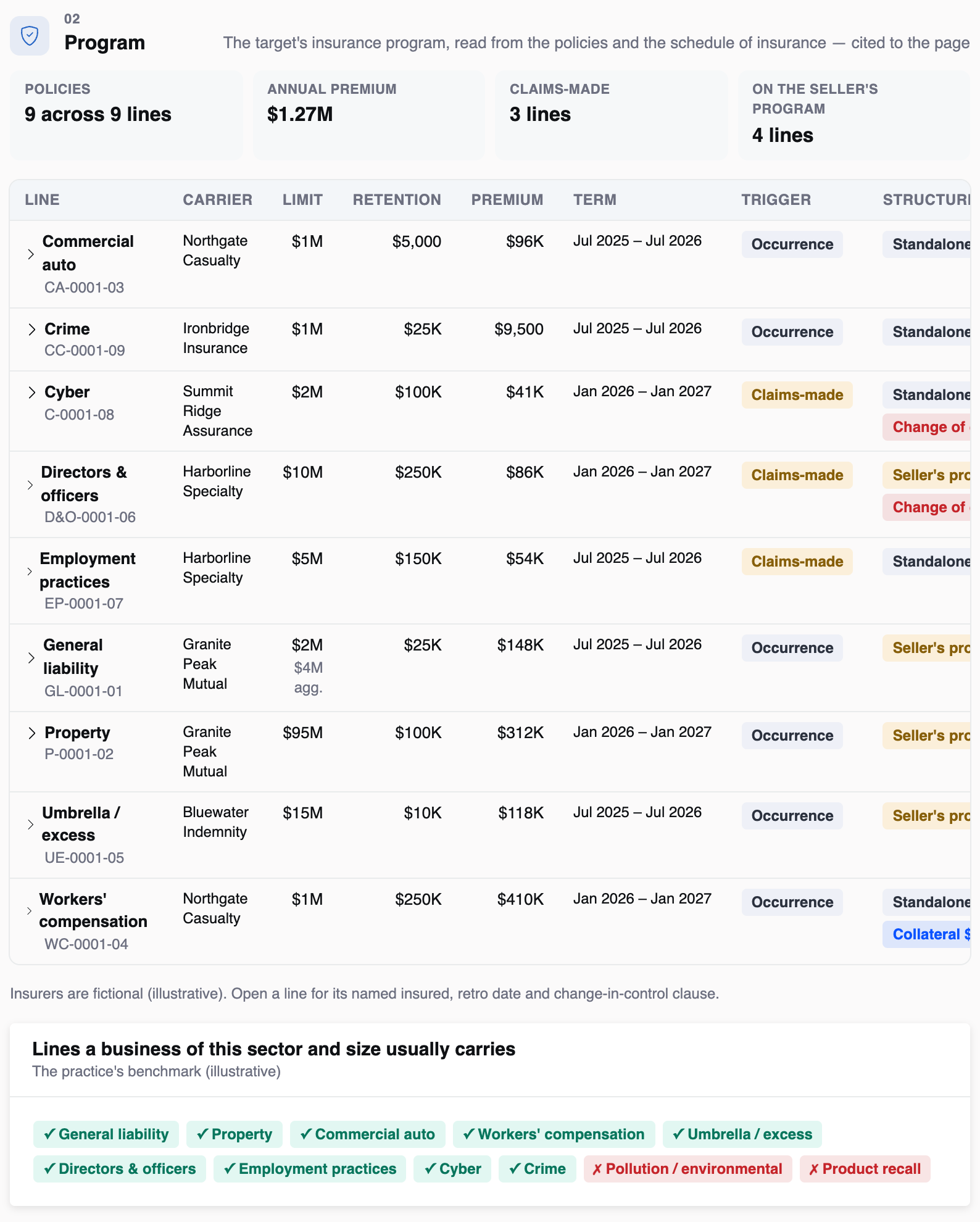
Nine policies across nine lines, $1.27M of annual premium, three claims-made, four on the seller’s program, $1.2M of workers’ compensation collateral on a letter of credit.
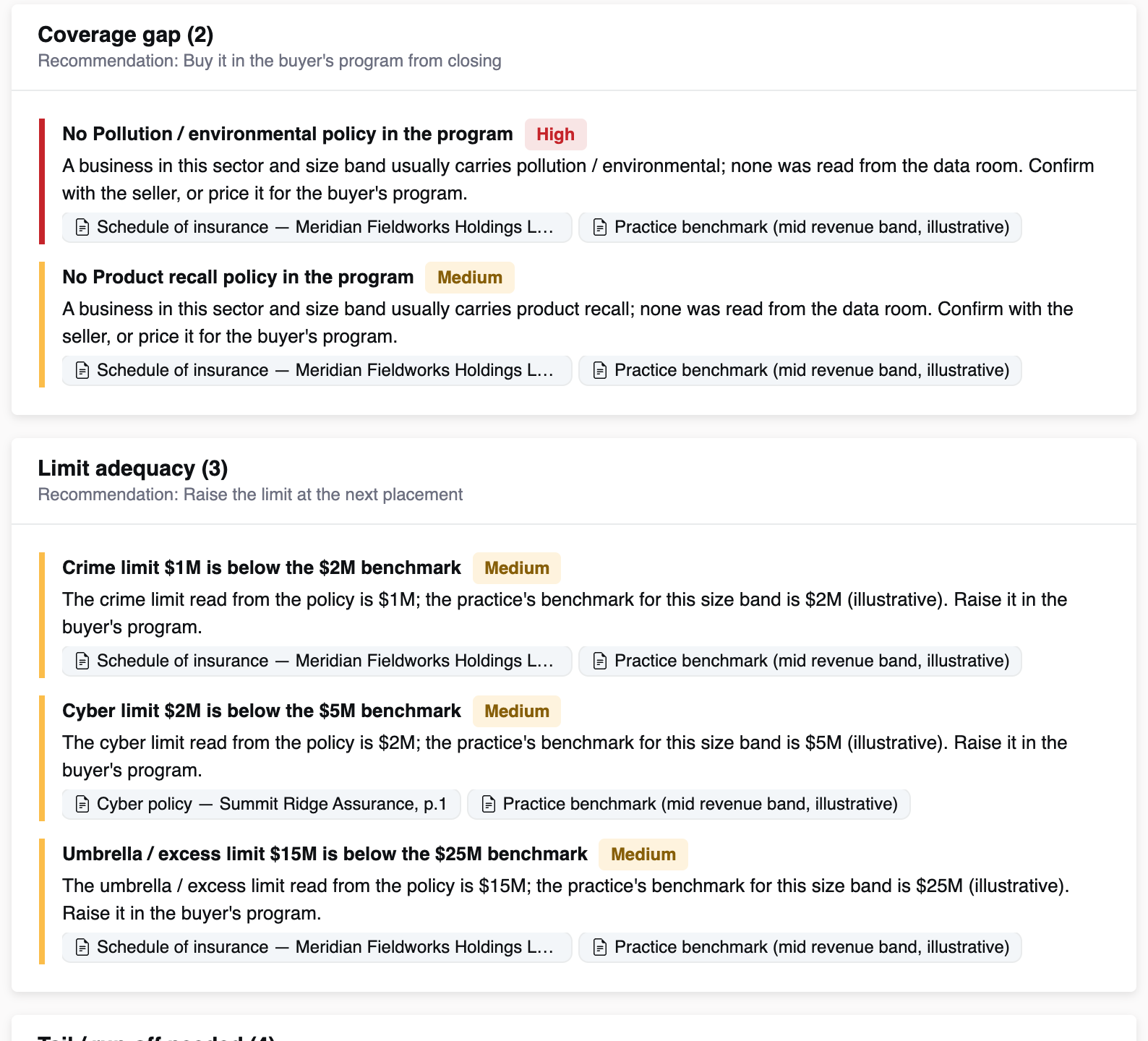
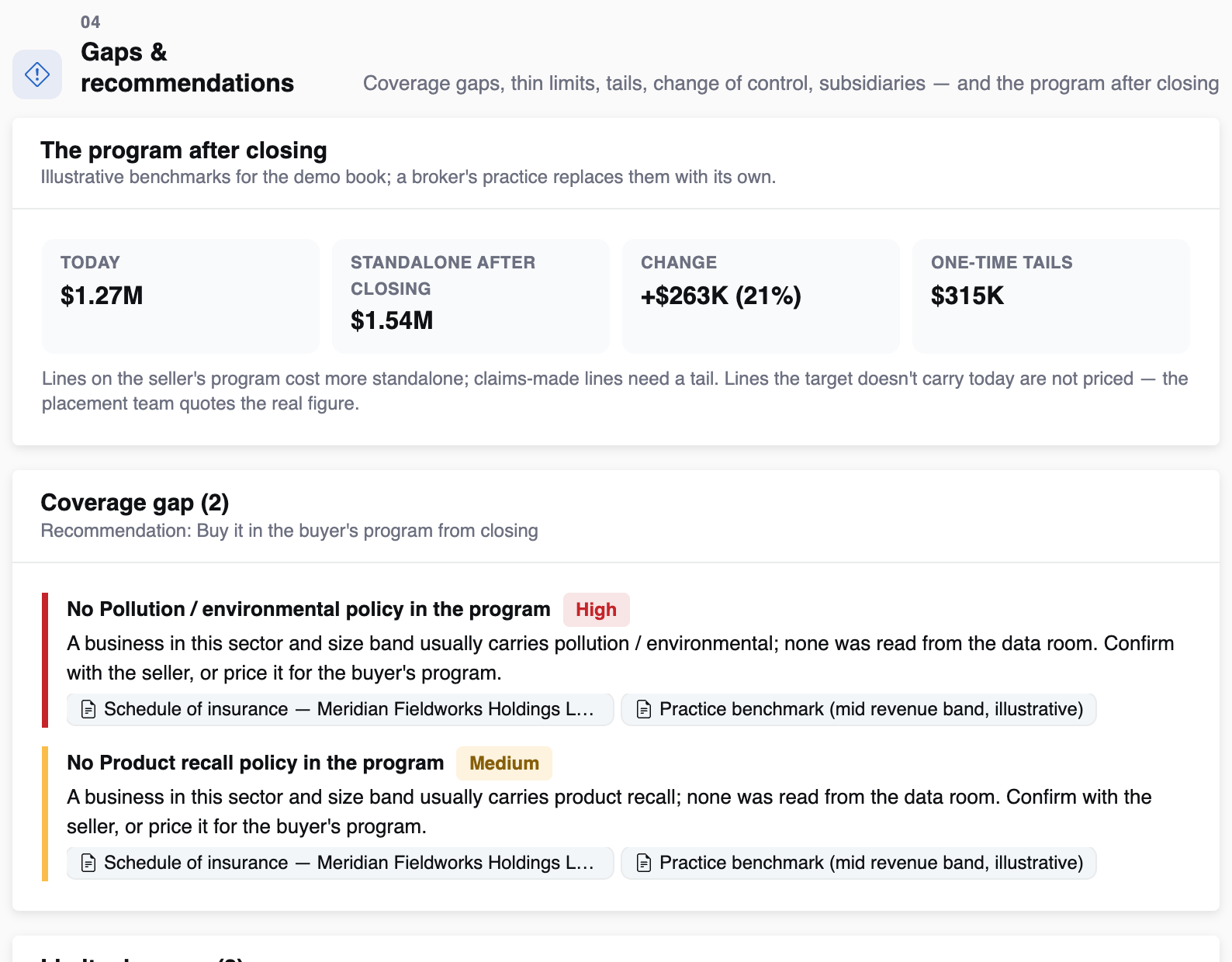
Against the practice’s illustrative benchmark for a mid-revenue industrial business: no pollution policy (high), no product recall (medium); crime $1M against $2M, cyber $2M against $5M, umbrella $15M against $25M.
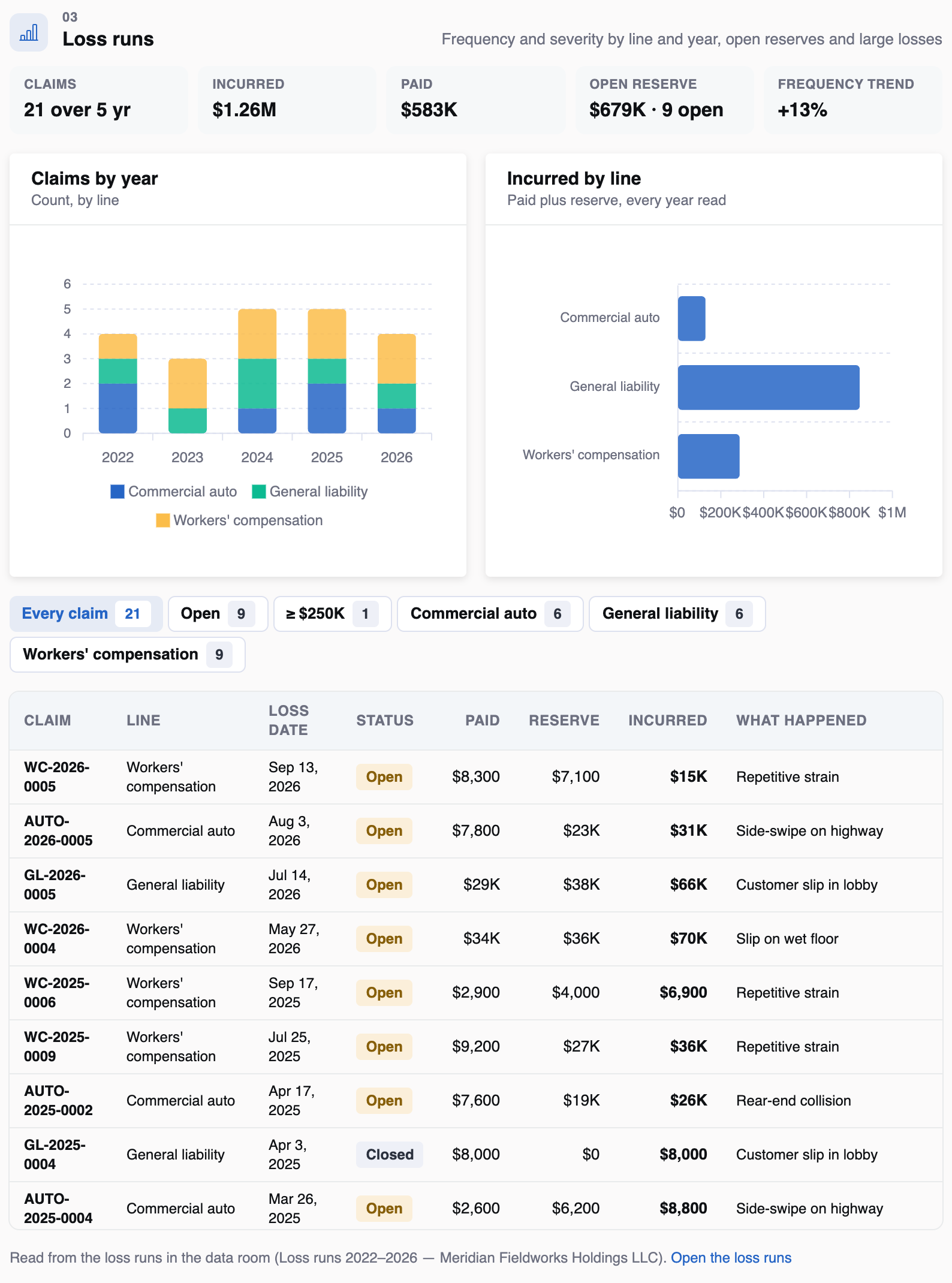
21 claims over five years, $1.26M incurred, nine open with $679K reserved, frequency up 13%; one general liability claim over the large-loss threshold.
D&O, EPL and cyber are claims-made and need tails; the sellers’ D&O needs a six-year run-off; the D&O converts to run-off on a change of control and the cyber policy needs the insurer’s consent.
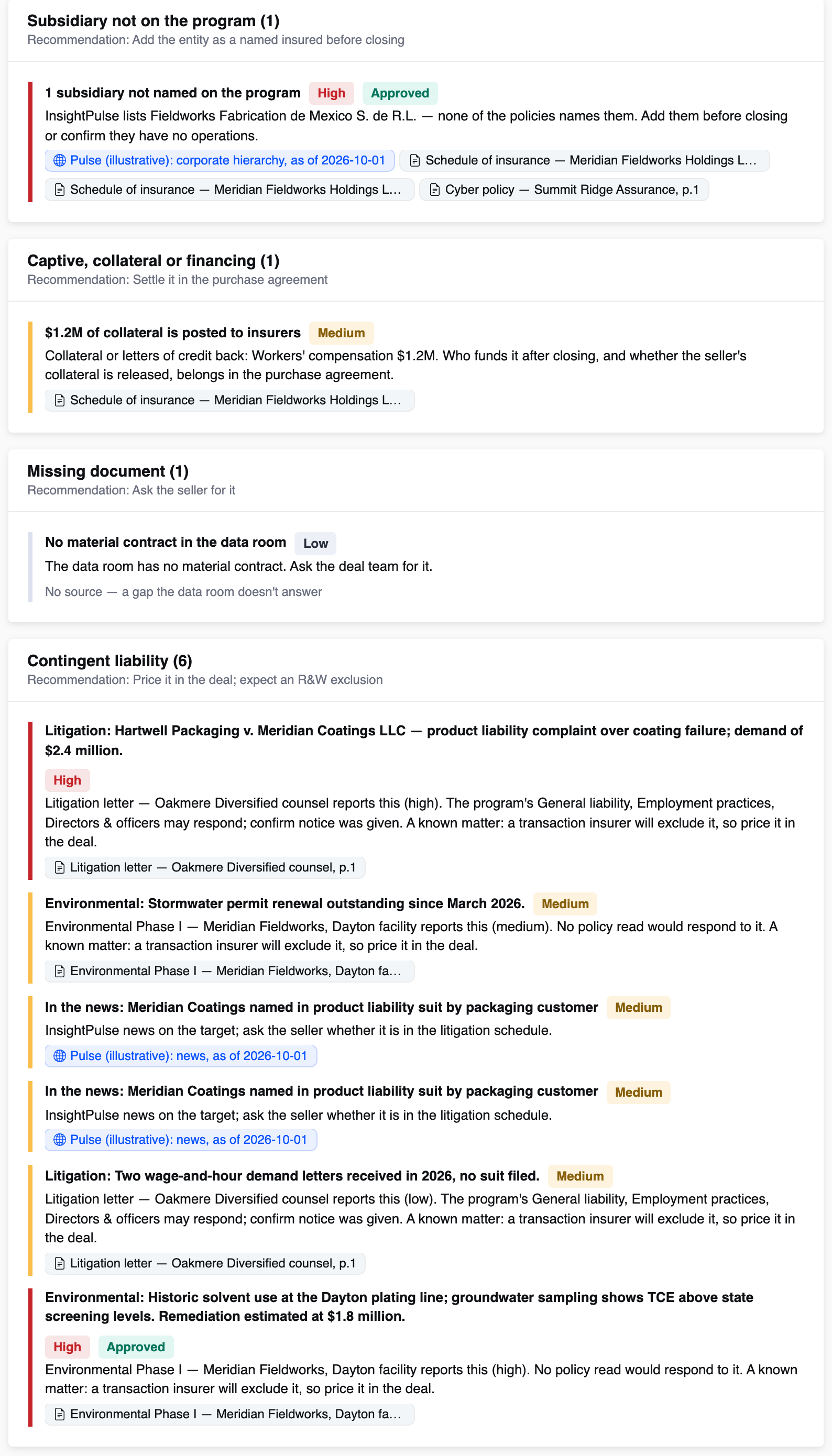
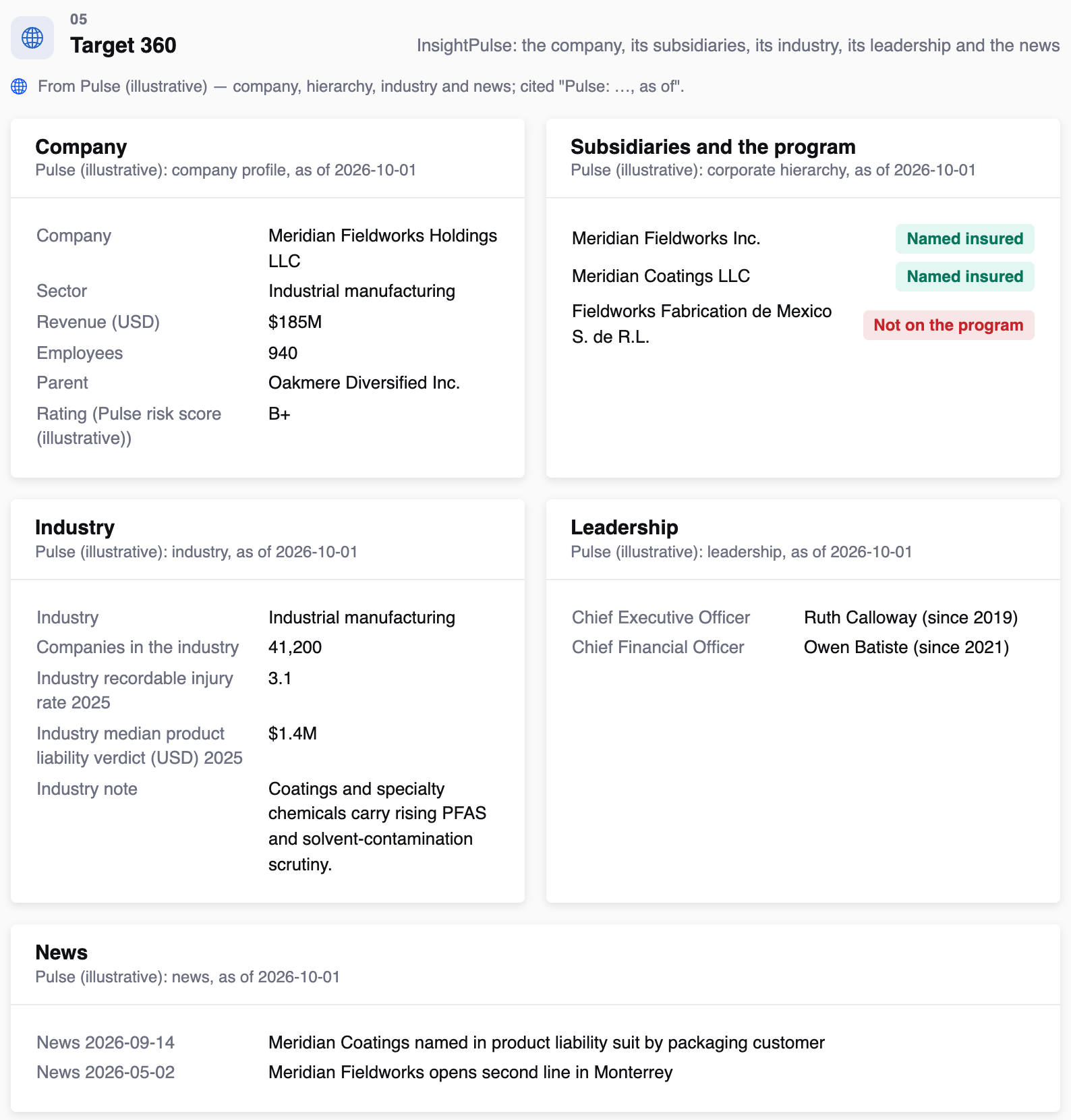
Pulse lists Fieldworks Fabrication de Mexico S. de R.L.; no policy names it.
The Hartwell Packaging product suit ($2.4M demand), TCE at the Dayton plating line ($1.8M estimated remediation), an outstanding stormwater permit, two wage-and-hour letters, and the news item on the suit.
Twelve high findings are unreviewed, so the report cannot issue: the control blocks and the supervisor agent prepares a practice leader sign-off.
The broker works the findings list: approves the tails, the D&O run-off clause, the Mexican subsidiary and the TCE finding; changes severities where the benchmark is only a guide; rejects background noise.
With the high findings reviewed, the block clears. The practice leader answers the prepared sign-off.
Six reviewed, R&W-relevant findings are shared with InsightDealDesk under contract diligence_findings.v1, where they land as likely exclusions.
Who talks to whom
What the screens show
What the agents said, and what each answer rests on
| Agent | What it prepared | What it cites | Who decides |
|---|---|---|---|
| Program | 9 policies across 9 lines; annual premium $1.27M; 4 on the seller’s program | Schedule of insurance p.1–3, three declarations | Broker reviews |
| Coverage gap | No pollution / environmental policy (high); no product recall (medium) | Schedule of insurance; practice benchmark (mid revenue band, illustrative) | Broker reviews |
| Loss run | 9 open claims with $679.2K reserved; frequency +13% | Loss runs 2022–2026 | Broker reviews |
| Tail & run-off | D&O converts to run-off at closing (quoted); cyber needs consent; tails estimated | D&O and cyber declarations, p.1 | Broker reviews |
| Subsidiary | Fieldworks Fabrication de Mexico S. de R.L. not named on any policy | Pulse: corporate hierarchy, as of 2026-10-01; schedule | Broker reviews |
| Contingent liability | TCE remediation estimated at $1.8M; no policy read would respond | Environmental Phase I, Dayton facility | Broker reviews |
| Supervisor | Practice leader sign-off: 1 control fired | Engagement control: high findings not reviewed | Practice leader |
The program after closing
Four lines move off the parent’s master program, so the report agent applies the practice’s illustrative uplift for parent-program lines and the tail multiples for the three claims-made lines. The result: about $1.54M a year standalone against $1.27M today (+$263K, 21%), plus $315K of one-time tails. Pollution and product recall are not priced; the placement team quotes them.
What happens to each kind of finding
Edge cases
| What happens | What InsightDueDiligence does |
|---|---|
| The same news item arrives twice | Both appear as findings with the same Pulse citation; the broker rejects the duplicate and the record keeps why. |
| The seller sends the material contracts late | Adding a document and pressing Analyze re-runs the playbook; earlier runs stay on the record. |
| The broker disagrees with the benchmark | Change the finding’s severity with a note; the benchmark itself is the practice’s to edit. |
| The report is due in a week with gaps open | “Due within a week with gaps open” refers it to a practice leader, who decides what goes out. |
| No InsightDealDesk endpoint configured | The share is held in the outbox; nothing leaves the product. |
On the deal desk
Seven documents became 30 findings with a page behind each. The time goes into reviewing them, not into re-typing the schedule, and the closing items — tails, run-off, the Mexican entity, the collateral — are already in the list.
For IT & architecture
Pulse is read through a signed lookup; the R&W hand-off is a signed POST with an idempotent fingerprint per finding. Every agent step has a trace with model, tokens and cost; the whole run on this engagement cost about one and a half cents.
For practice leaders
The report cannot go out with high findings unreviewed, by rule, and the record shows who reviewed each one. The same findings feed the R&W placement, so the exclusion and the finding are one record.
Questions we get asked
Would a real Phase I be read the same way?
Yes, through InsightXtract in production, into the same page-level pieces. The demo uses a stand-in reader over synthetic text, and says so on the Documents zone.
Does the buyer see the agents’ reasoning?
The buyer sees the report, built only from reviewed findings with their citations. The reasoning stays in the workspace and the trace.
Keep reading
A software target with uncapped contracts
Three enterprise contracts promise more than the cyber policy can pay.
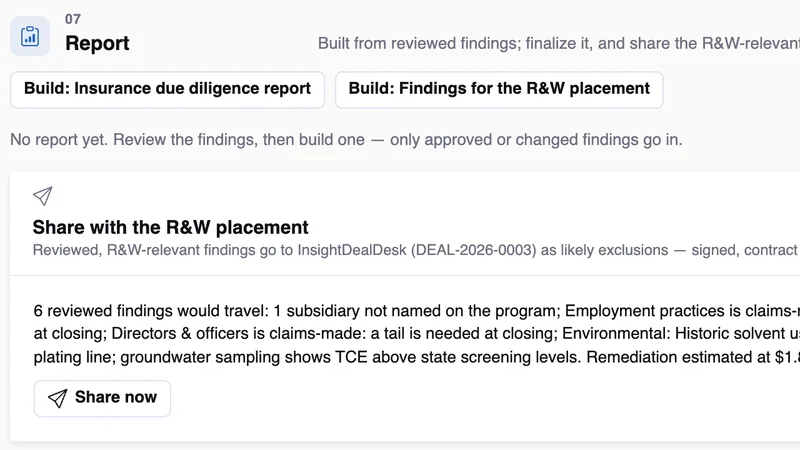
From diligence finding to R&W exclusion: the hand-off to InsightDealDesk
A reviewed finding travels, signed, and lands as a likely exclusion.