InsightDueDiligence · Insurance due diligence on deal targets
Every policy read. Every page cited. Every finding reviewed
Nine agents read the target’s data room and what InsightPulse knows about it, reason over it with Claude and prepare the findings and the report. The engines compute every figure; every finding cites its page. Nothing reaches the buyer until a broker has reviewed it.
7reviews in the demo book: six targets, one vendor
30findings on one industrial target, 12 of them high
9agents; every action ask-first by default
~1.5¢model cost of a full Analyze (24 calls)
Illustrative: figures from the fictional demo book shown on this site. Your engagements will differ.
Diligence Workspace · Meridian Fieldworks
Prepared for you · Supervisor agent
Meridian Fieldworks (illustrative) at Review: 12 high findings still open, so the supervisor agent holds the report and asks a practice leader to sign off.
What every engagement answers
The program in forceCoverage gaps & thin limitsFive years of loss runsLarge & open lossesTails & D&O run-offChange-of-control clausesSubsidiaries not on the programCaptives, collateral & financingContingent liabilitiesThe program after closing
Proof, not promises
Three screens from the demo book, as they are
The running product on a fictional industrial target. The agents’ text is what Claude wrote; every figure is the engines’. Click a screen for the full page.
Program · Meridian Fieldworks
1
The program, read from the policies
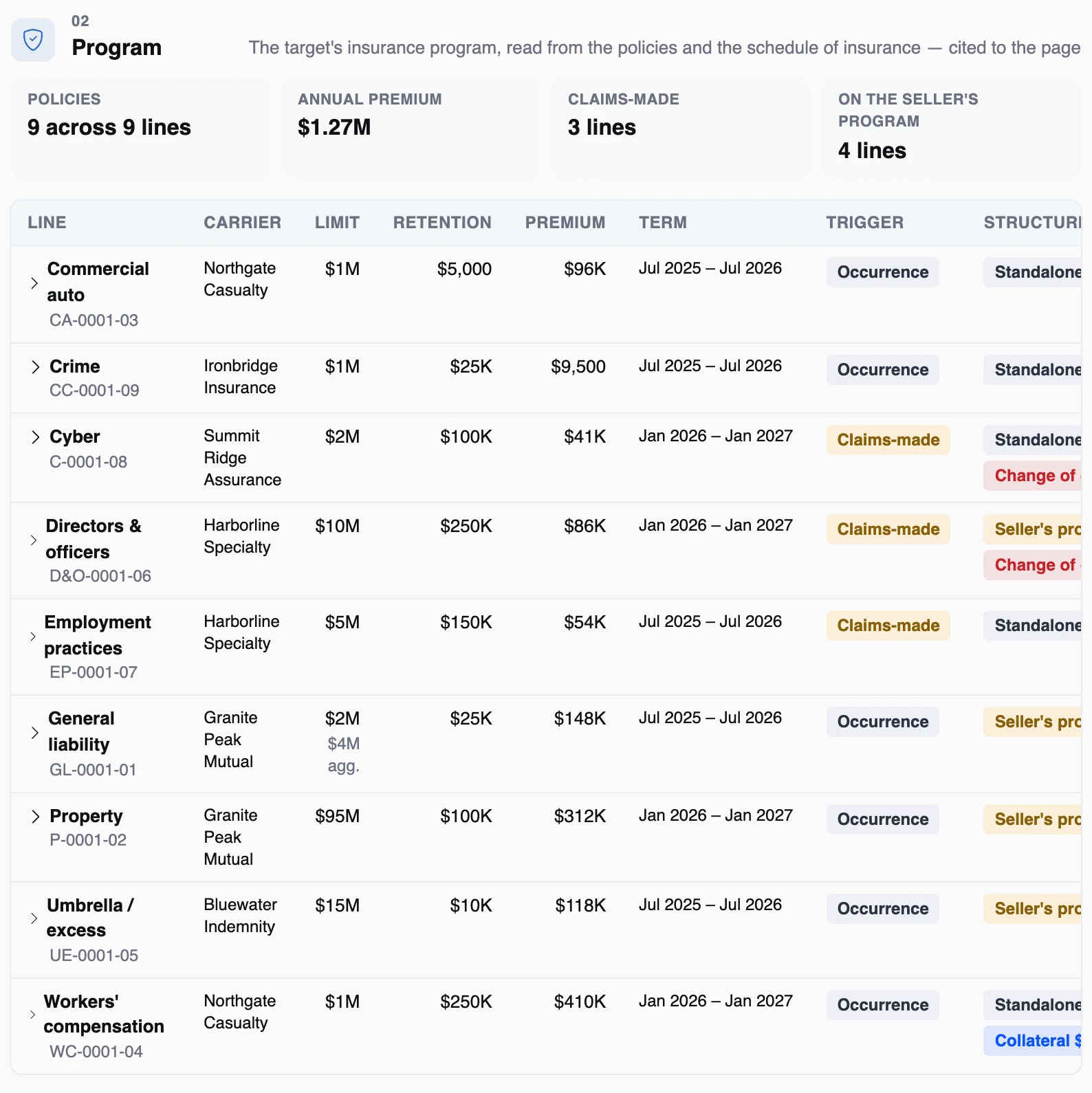
Nine policies across nine lines and $1.27M of premium, each read from the schedule and the declarations with its page. Three lines are claims-made; four sit on the seller’s master program.
Those are the lines that change at closing — so they are flagged before anyone builds a spreadsheet.
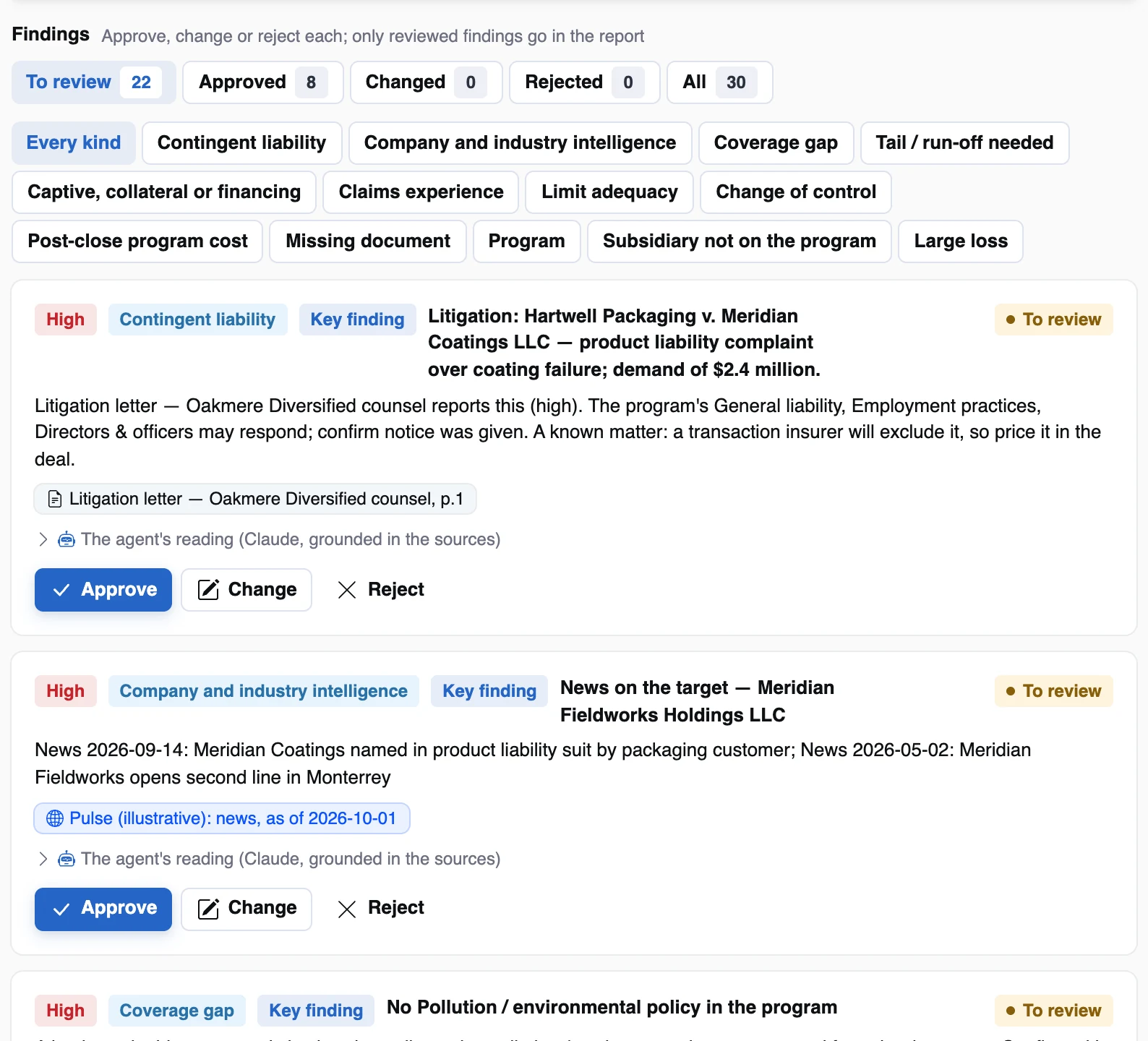
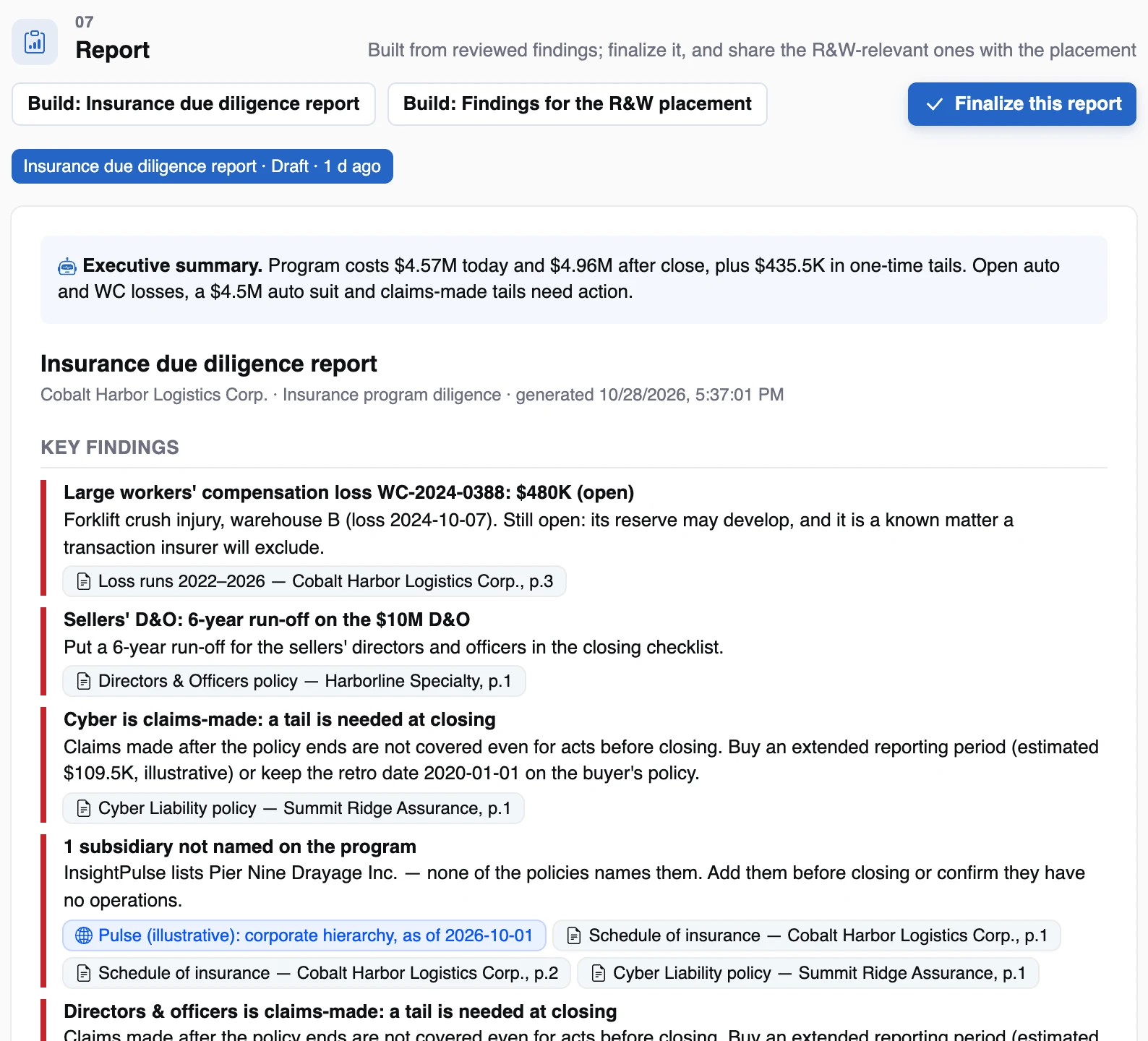
A $2.4M product liability demand, cited to the litigation letter; the same suit in the news, cited to InsightPulse with its as-of date. A broker approves, changes or rejects each one — only reviewed findings reach the report.
Insurance diligence is spent re-typing, and the surprises are in the clauses
Forty documents and three weeks. The hours go into copying limits into a spreadsheet; what hurts the buyer after closing is in the declarations, the conditions and the hierarchy.
Tails
Claims-made cover that stops
D&O, E&O, cyber and EPL end or convert at closing. A claim next year for an act last year finds no policy.
Parent program
Lines that leave with the seller
Lines on the seller’s master program end at closing, and the standalone price is a number nobody modelled.
Structure
The entity nobody named
The hierarchy has an operating subsidiary that no policy names, sometimes in another country.
Hand-off
Findings re-typed into the R&W placement
The R&W team reads the report as a PDF; nobody can say which finding became which exclusion.
The product
Everything an insurance diligence report needs
A workspace per engagement, nine agents that prepare the work, and the controls that hold the report until a person signs.
One target’s program against a 25-question playbook. Every step after Analyze is something a broker can open and check.
1
Read
The data room into page-level pieces (InsightXtract in production); InsightPulse for the company and its hierarchy.
2
The engines compute
Premium, claims by line and year, gaps against the benchmark, tails, the cost after closing.
3AI
Nine agents reason
With Claude, over their cited facts, and prepare findings and decisions.
4
Grounding check
A number not in the facts throws the answer away; the check’s own finding stands.
5
A broker reviews
Approve, change or reject each finding against its page. Controls hold the report while high findings wait.
6
Report & hand off
Built from reviewed findings only; R&W-relevant ones go, signed, to InsightDealDesk.
Rejected findings are kept on the record. Nothing is deleted: the report leaves them out, and the decision record shows who rejected what, and why.
The agents prepare; the engines compute every figure; a broker decides. Each step is traced with its model, tokens and cost.
The Diligence Workspace
One page per engagement, with the agents’ work on top
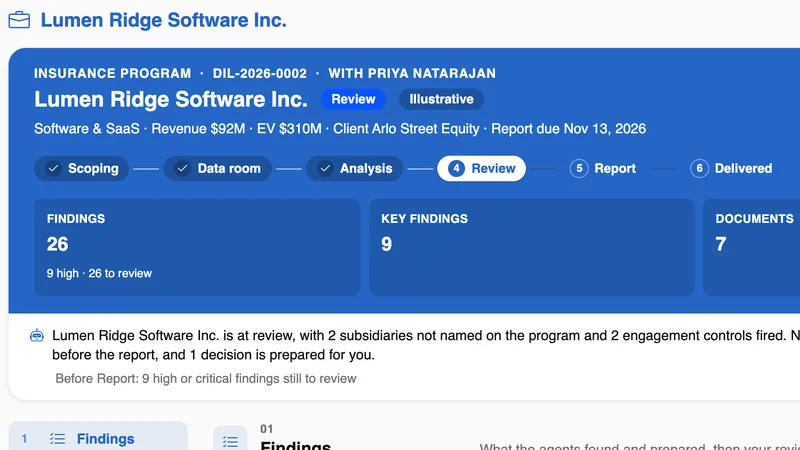
The hero says where the engagement stands — Scoping, Data room, Analysis, Review, Report, Delivered. Below it, seven zones: Findings, Program, Loss runs, Gaps & recommendations, Target 360, Documents and Report.
Findings
Findings. Each with its severity, category, citations and the agent’s reading — approve, change or reject. Only reviewed findings reach the report.
Program
Program. Every policy read from the schedule and the declarations — structure, triggers and the benchmark lines.
Loss runs
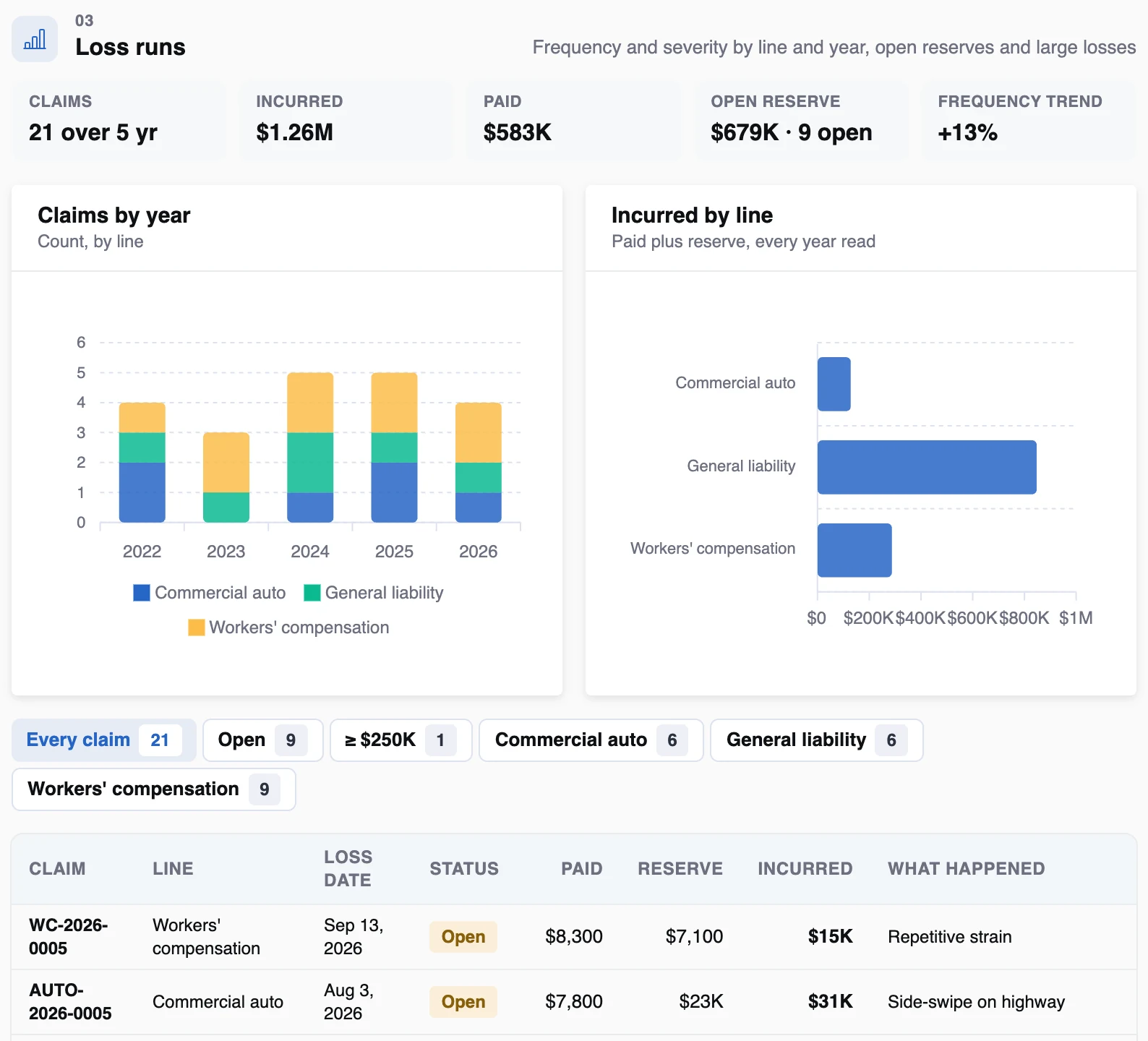
Loss runs. Frequency and severity by line and year, open reserves, large losses and the trend.
Gaps & recommendations
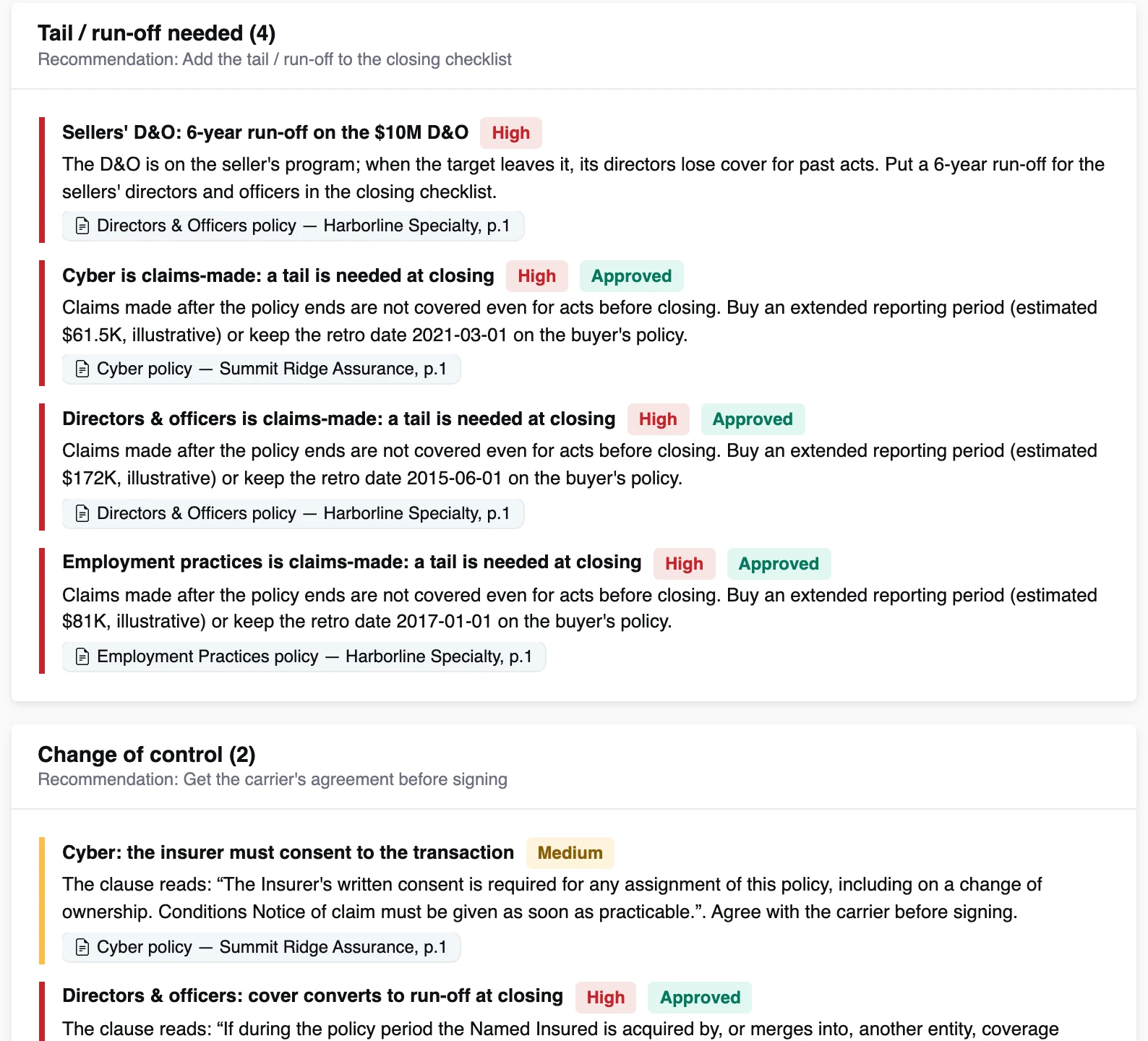
Gaps & recommendations. Tails, run-off and the clauses that act at closing, quoted with their page.
Target 360
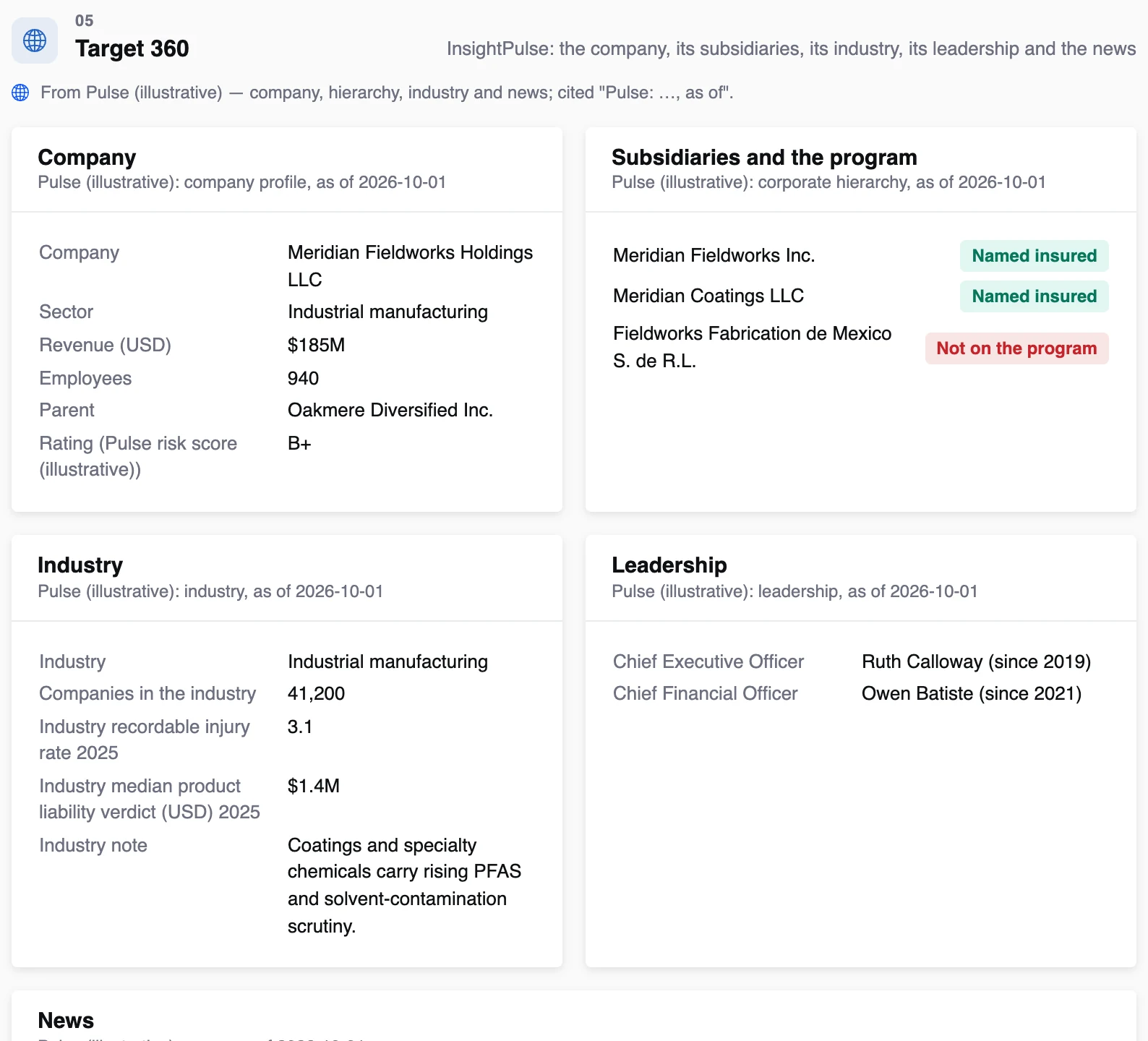
Target 360. InsightPulse’s company, hierarchy, industry, leadership and news — subsidiaries checked against the named insureds.
Report
Report. Built only from reviewed findings, each citing its page; finalize it and deliver.
The agents
Nine diligence agents, each with one job and a hard limit
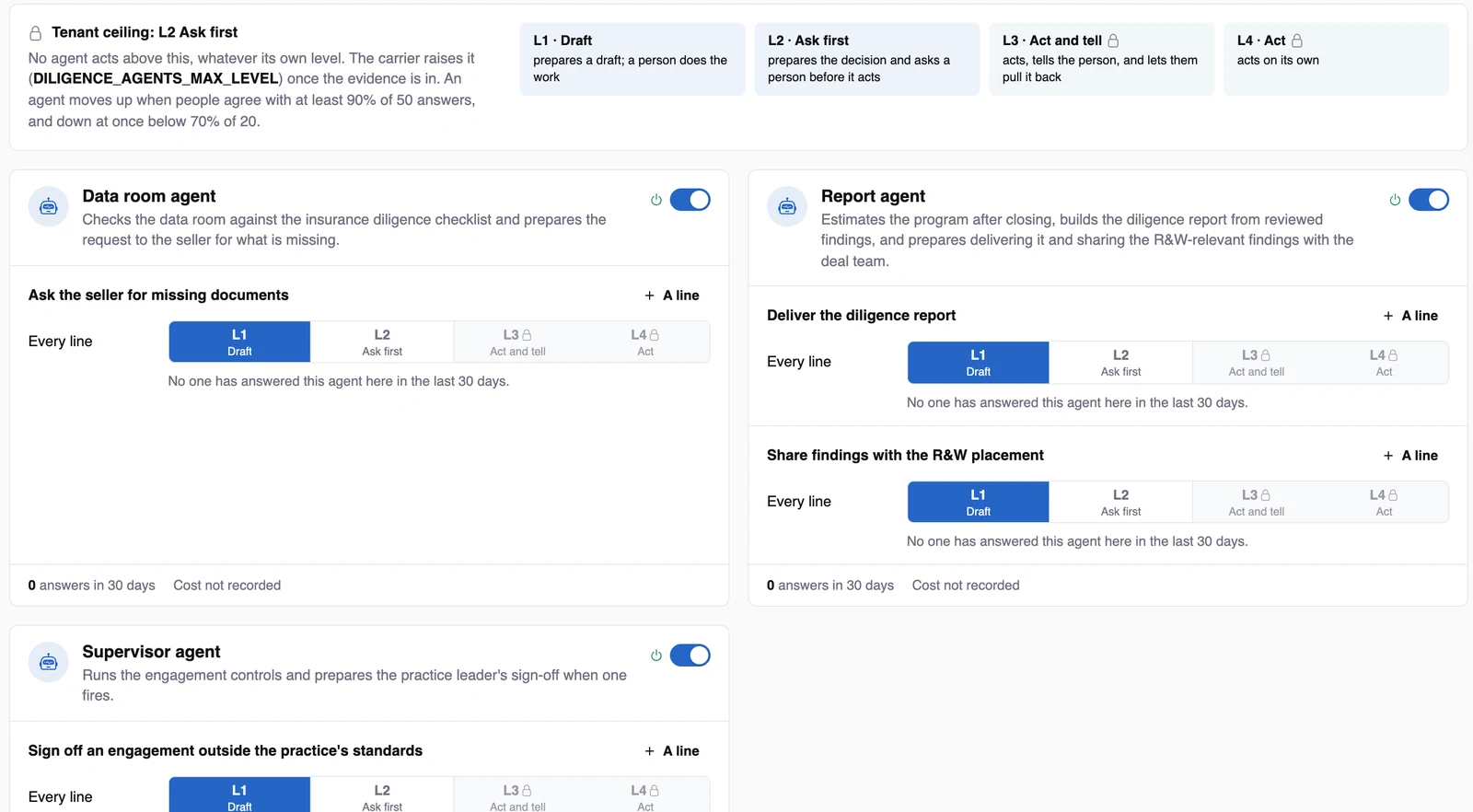
The first seven work the playbook; each finds the facts with a check, then reasons over them with Claude. Four actions exist, and every one is capped at ask first, whatever the dial says.
Data room
The checklist: policies, five years of loss runs, contracts, a litigation letter.
Prepares the seller request
Program
Every policy into the program: lines, carriers, limits, retentions, premiums, triggers, structure.
Coverage gap
The program against the practice’s benchmark for the sector and size: missing lines, thin limits.
Loss run
Frequency and severity by line and year, open reserves, large losses, the trend.
Tail & run-off
Claims-made tails, the sellers’ D&O run-off, change-of-control clauses.
Subsidiary
InsightPulse’s hierarchy against the named insureds; company, industry, leadership.
Contingent liability
Litigation, environmental, product and warranty exposure, and whether the program responds.
Report
The program after closing; the report from reviewed findings.
Prepares delivery & the hand-off
Supervisor
Runs the engagement controls; writes the practice leader’s brief.
Prepares sign-off; never decides
Copilot
Answers questions about the engagement from eight read-only tools, with numbered sources. Never acts.
The autonomy dial
The level for any action is the lowest of three: the agent’s level, the action’s hard cap and the practice’s ceiling. The ceiling ships at L2.
L1
Draft
The agent drafts; a person does the work. Where every action starts.
Default ceilingL2
Ask first
The agent prepares the decision; a broker accepts, changes, rejects or asks.
L3
Act and tell
Acts, tells the person and lets them pull it back.
L4
Act
Acts on its own — only if the practice raises the ceiling.
AI & Agents · Catalogue
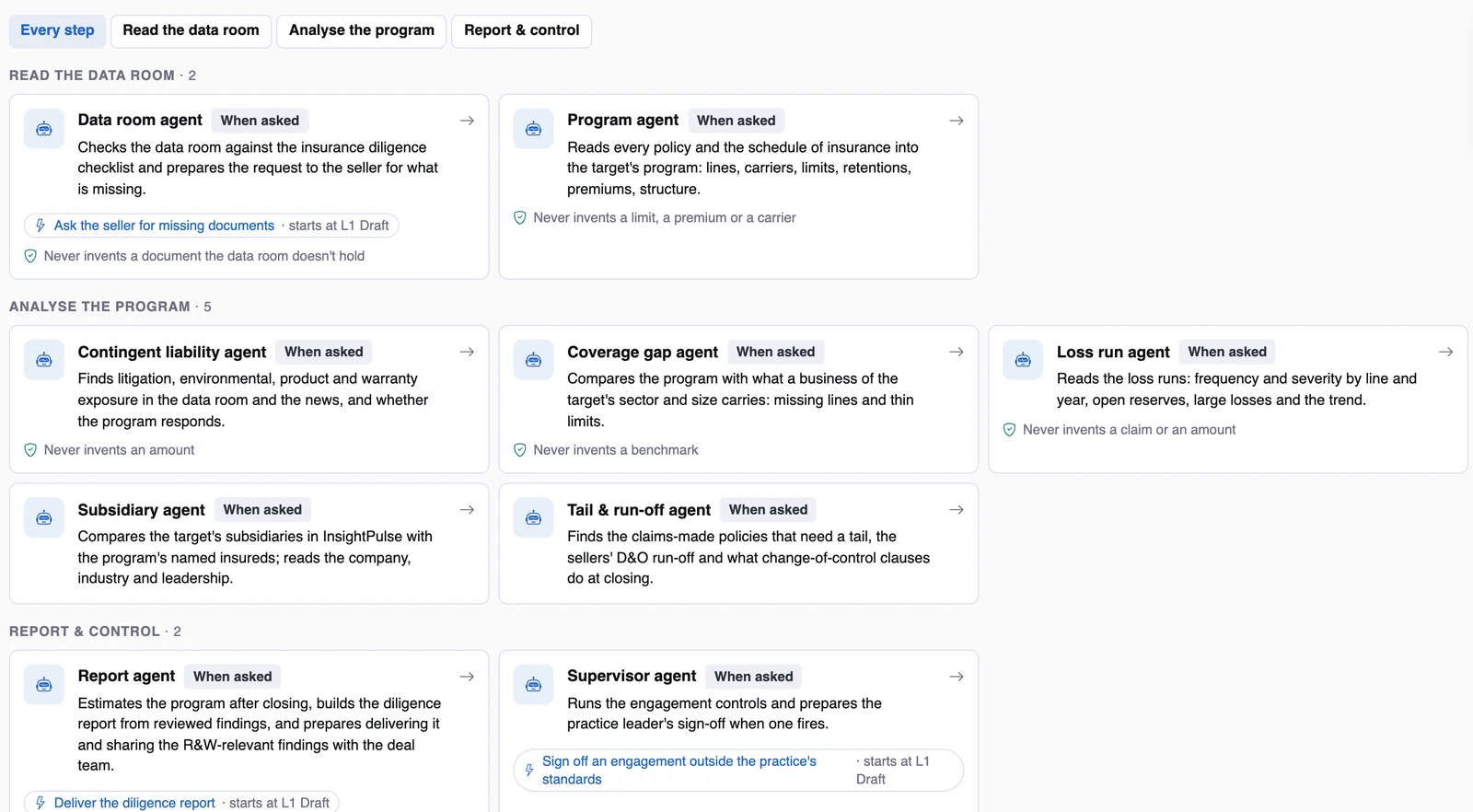
Catalogue. The nine agents by step, what each never invents, and the actions they may propose.
Tail & run-off agent · Trace
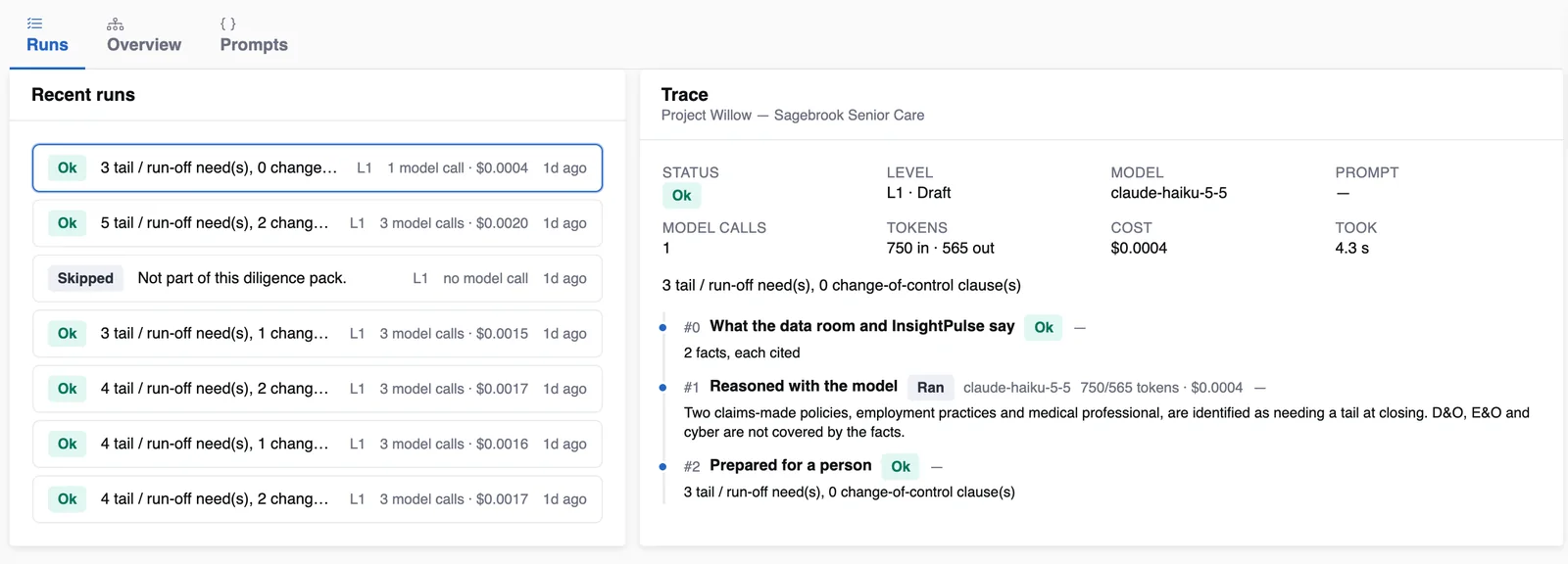
Run trace. The facts, the model call with tokens and cost, and what it prepared.
AI & Agents · Autonomy
Autonomy. The ceiling, the four levels and each agent’s level per action.
AI & Agents · Activity
Activity. Every agent step on the book, what it prepared and what is waiting on a person.
The diligence copilot
Ask the engagement. Get an answer with its sources
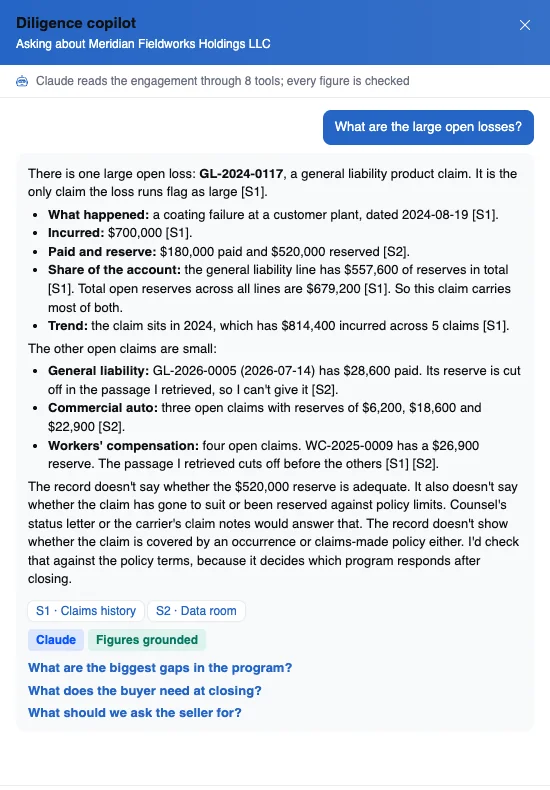
The copilot answers from eight read-only tools on the engagement in front of you — overview, program, claims, findings, gaps, Target 360, data room search and the cost after closing — and says what the record does not hold.
Every figure checked against what it read; an unsupported one becomes “not in the record”
Only engagements in your scope
Suggests follow-up questions — it never takes an action
Facts-only mode when no model is configured, and it says so
Diligence copilot · “What are the large open losses?”
Controls
Standards a practice leader can read, and a report that waits for them
Rules Studio
Engagement controls
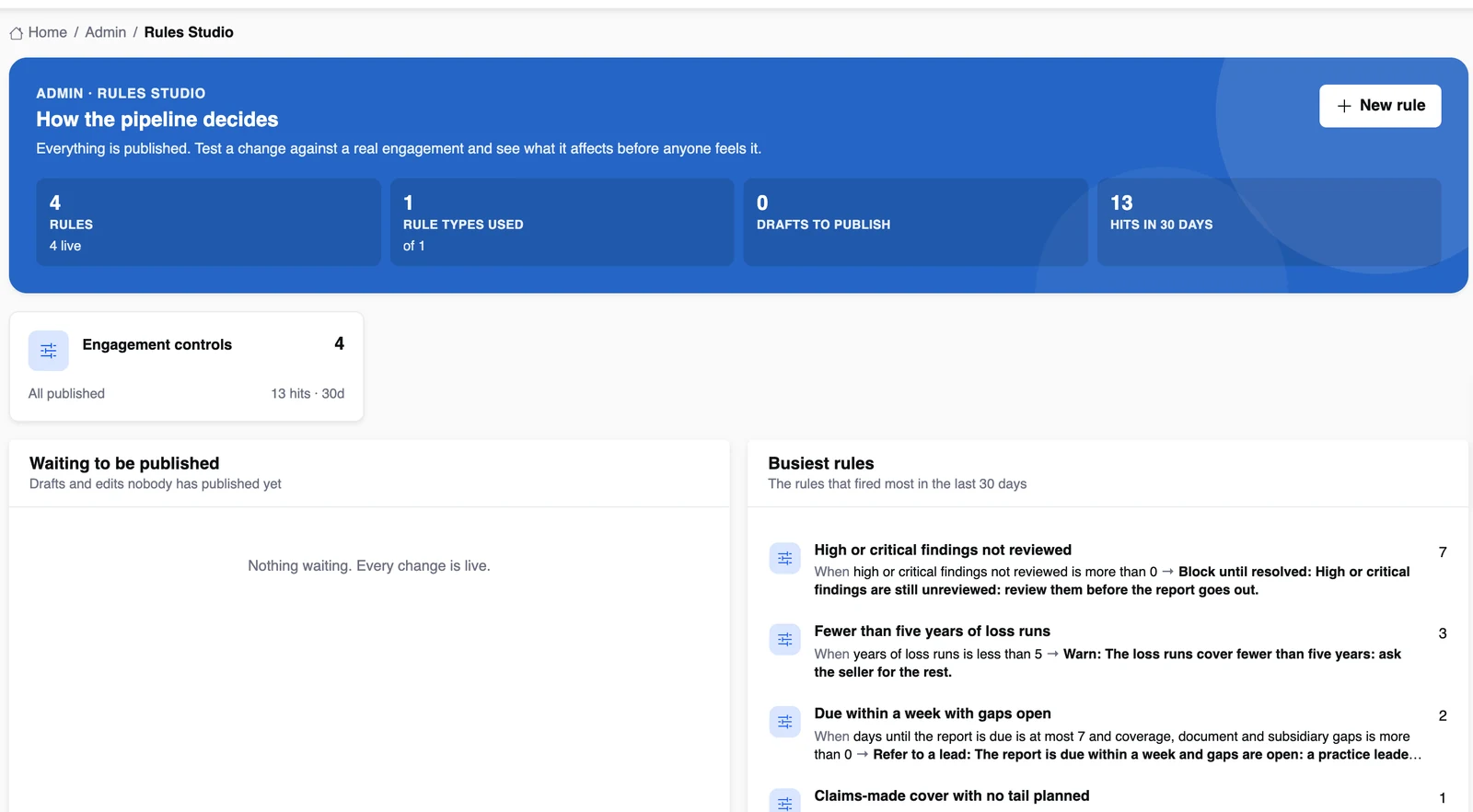
High findings unreviewed (block), loss runs shorter than five years (warn), claims-made cover with no tail planned and due within a week with gaps open (refer) — written, tested on a real engagement and versioned.
Decision record
Signed, in order
Every control run, finding review and answer to a prepared decision, with who signed it. Runs are appended, never overwritten.
Stage machine
No shortcuts
No Analysis without documents, no Report with high findings pending, no Delivered without a final report and with a blocking control firing.
Rules Studio
Rules Studio. The engagement controls and how often each fired — the same Studio InsightDealDesk uses for placement controls.
The connected suite
Diligence that feeds the placement
Company intelligence from InsightPulse and documents through InsightXtract in; reviewed findings out to the R&W placement in InsightDealDesk under a signed, versioned contract.
Does an agent send anything to the seller or the client?
No. Asking the seller, delivering the report, sharing with the R&W placement and signing off are all capped at ask first. Outside production, sends are dry runs and nothing leaves the product.
What stops the model inventing a limit or a premium?
The engines compute every figure; the model only reasons over them. Any number in a model answer that is not in the facts throws the answer away, and the check’s own finding stands.
Whose benchmarks are the gaps measured against?
The practice’s. The demo ships illustrative benchmarks by sector and revenue band, uplift by program structure and tail multiples; a practice replaces them with its own.
Do we need InsightDealDesk?
No. Without it the report stands alone and the hand-off is held. With it, reviewed findings reach the R&W placement as likely exclusions without re-typing.
See the agents read a data room
Bring an anonymised data room from a closed deal and watch the agents read the program, the loss runs and the clauses in a 30-minute walkthrough.