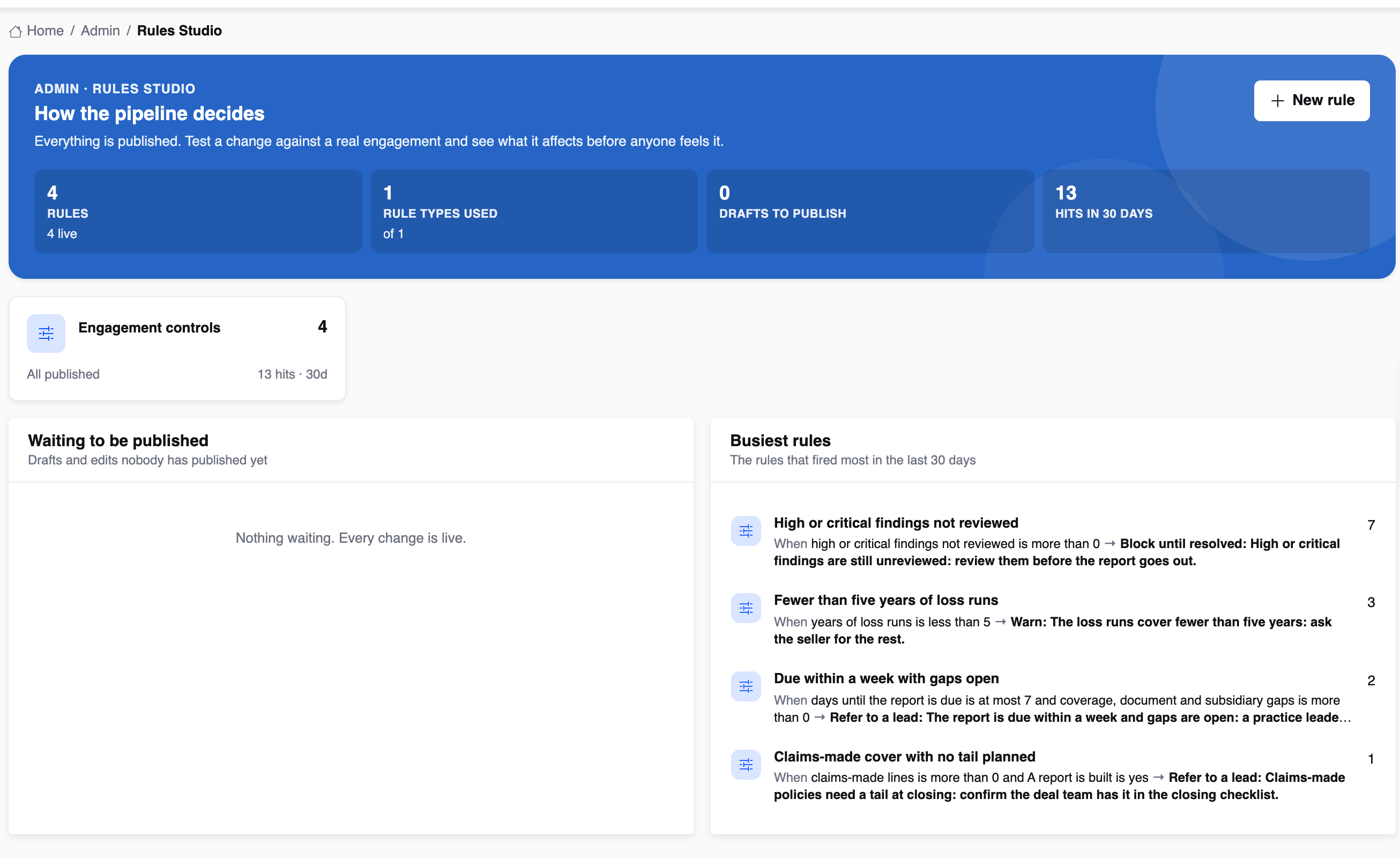
Every deal practice has standards a report must meet before it goes to a client: nothing serious left unreviewed, enough loss history to say anything, the tails on the closing checklist. In most practices those standards live in a partner’s head. In InsightDueDiligence they are engagement controls in the Rules Studio, written as sentences a practice leader can read.
The four starter controls
| Control | When it fires | Effect |
|---|---|---|
| High or critical findings not reviewed | Any high or critical finding is still pending review. | block |
| Fewer than five years of loss runs | The loss runs read cover fewer than five years. | warn |
| Claims-made cover with no tail planned | There are claims-made lines and a report has been built. | refer |
| Due within a week with gaps open | The report is due within seven days and coverage, document or subsidiary gaps are open. | refer |
They ship with the insurance_program pack and are seeded on start-up. A practice edits
them, adds its own and retires the ones it does not want.
What a control reads
A control is a predicate over the engagement’s facts: its sector, stage and pack, how many findings are pending at high or critical, how many years of loss runs were read, how many lines are claims-made, whether a report has been built, days until the report is due, and the open coverage, document and subsidiary gaps. The facts are computed fresh on every evaluation; a control never reads a model’s opinion.
(computed)"] --> C1{"pending_high > 0"} C1 -- yes --> B["block: hold the report"] E --> C2{"loss_years < 5"} C2 -- yes --> W["warn: ask for the rest"] E --> C3{"claims_made > 0
and report built"} C3 -- yes --> R1["refer: confirm the tail
is on the closing checklist"] E --> C4{"due in 7 days
and gaps open"} C4 -- yes --> R2["refer: practice leader
decides what goes out"] style B fill:#fdecec,stroke:#e57373 style R1 fill:#e6efff,stroke:#2563eb style R2 fill:#e6efff,stroke:#2563eb style W fill:#fff4e2,stroke:#f4a03a
Draft, test, publish
A draft can be run against any open engagement to see what it would do before anyone feels it. Only published rules are evaluated, on every Analyze and when the engagement moves to Delivered. Every publish is a new version with an audit entry, and the studio shows how often each rule fired in the last 30 days.
What happens when one fires
The supervisor agent runs the controls as the last step of Analyze and writes the run to the decision record. If any control refers or blocks, it prepares a practice leader sign-off with the controls that fired and the facts behind them, reasoned with Claude into a short brief. The stage machine applies the blocking ones directly: an engagement cannot move to Delivered while a blocking control fires.
The same studio across the suite
The Rules Studio is the shared Insight component also used by InsightDealDesk for its placement controls. A practice that runs both learns one way of writing, testing and publishing rules.
Questions we get asked
Can a control call the model?
No. Controls are deterministic predicates over computed facts, so the same engagement always gives the same result.
Can we make the loss-run control a block?
Yes. The effect is part of the rule; changing warn to block is an edit, a test and a publish.

