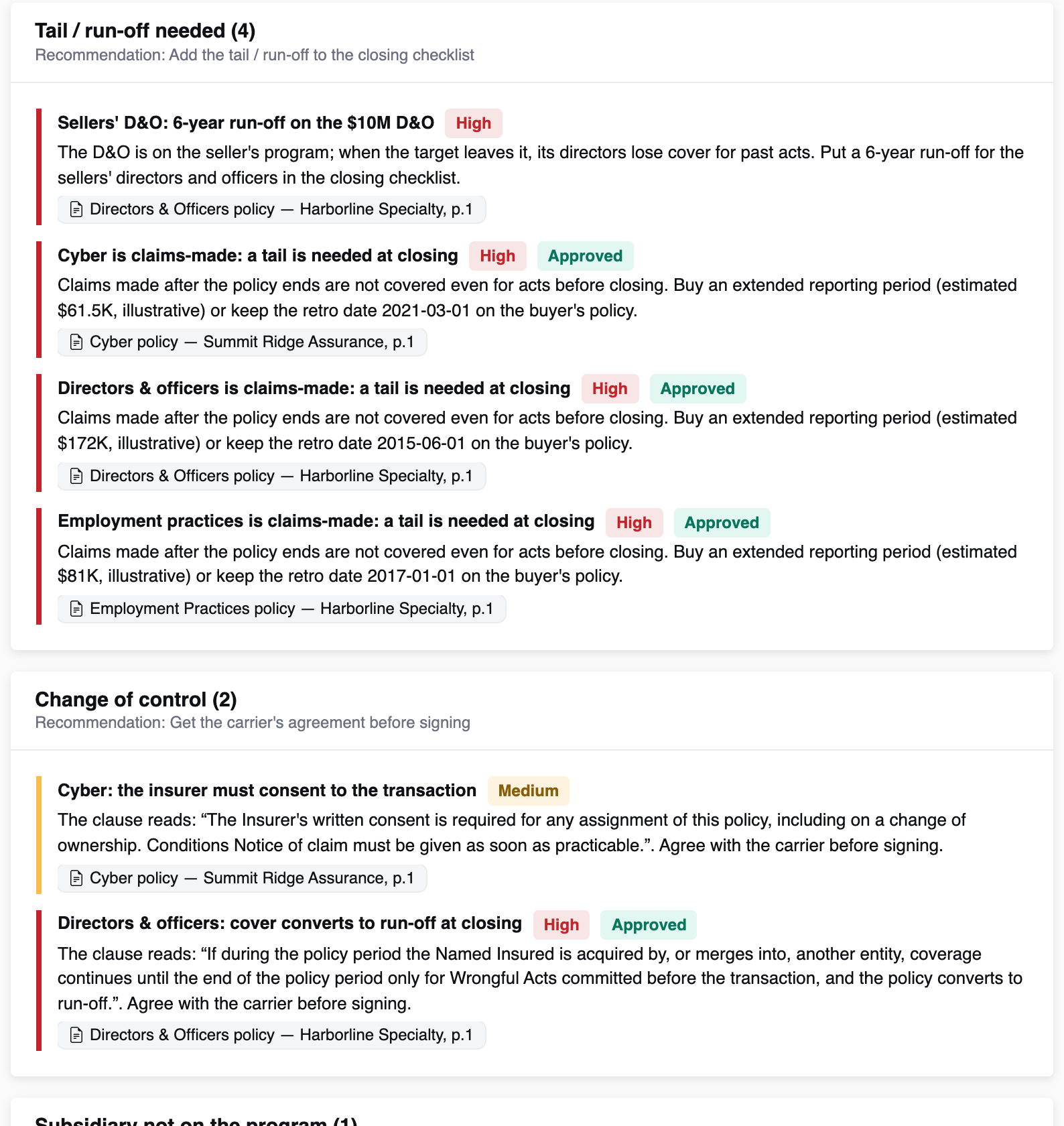
A claims-made policy covers claims made while it is in force. When the target is sold, the seller’s D&O, E&O, cyber, employment practices or medical professional policy usually ends or converts, and a claim made next year about something done last year finds no policy to answer it. The fix is cheap compared with the problem — a tail or a run-off — but only if someone notices before closing.
Three closing problems, one agent
| Problem | What the agent reads | Recommendation |
|---|---|---|
| Claims-made cover ends | The trigger and retroactive date on each policy’s declarations. | Buy an extended reporting period, or keep the retro date on the buyer’s policy. |
| Sellers’ directors exposed | A D&O on the seller’s program or converting at closing. | A six-year run-off for the sellers’ directors and officers, on the closing checklist. |
| A clause acts at closing | Change-of-control and assignment clauses in the conditions, quoted. | Agree with the carrier before signing. |
What a policy does at closing
The illustrative book has all three clause types, read from the policies’ conditions and quoted on screen:
- Converts to run-off: “If during the policy period the Named Insured is acquired by, or merges into, another entity, coverage continues until the end of the policy period only for Wrongful Acts committed before the transaction, and the policy converts to run-off.”
- Terminates: “This policy terminates automatically on the date any person or entity acquires more than 50% of the Named Insured.”
- Needs consent: “The Insurer’s written consent is required for any assignment of this policy, including on a change of ownership.”
How the agent works it
policy declarations"] --> R["Reader: trigger,
retro date, clause,
with the page"] R --> Q1["Which claims-made
lines need a tail?"] R --> Q2["What D&O run-off
do the sellers need?"] R --> Q3["What do the change-of-
control clauses do?"] Q1 --> F["Findings: tail_needed,
change_of_control"] Q2 --> F Q3 --> F F --> M["Claude: which
matter most, what to ask"] M --> RV["Broker reviews
each finding"] style F fill:#e6efff,stroke:#2563eb style RV fill:#e7f8f1,stroke:#10b981
The tail estimate is the engine’s: the annual premium times the practice’s multiple for the line. On the illustrative software target the agent found five tail needs — cyber, D&O, employment practices, technology E&O and the sellers’ D&O run-off — and two clauses that act at closing, including a cyber policy that simply ends.

Why these findings travel to the R&W placement
Tail needs are one of the categories InsightDueDiligence shares with InsightDealDesk once a broker has reviewed them. A closing condition the R&W underwriter will ask about is better known to the placement team before the underwriting call than discovered on it.
The engagement control that backs this up
“Claims-made cover with no tail planned” refers the engagement to a practice leader once a report has been built and claims-made lines exist, so the question “is the tail on the closing checklist?” is asked every time, by rule.
Questions we get asked
Is six years always right for D&O run-off?
Six years is the illustrative default in the pack’s benchmarks. A practice sets its own.
What if the retro date is missing?
The finding says “not stated” and the open question goes to the seller. The agent does not guess a date.
