
A growth equity buyer is acquiring a founder-led analytics software company. On paper the insurance program is tidy: technology E&O, cyber, D&O and EPL, all standalone. The trouble is in two places nobody reads first — the customer contracts and the policy conditions. This post follows the engagement. The target, the parties, the carriers and every figure are illustrative.
| Engagement | Project Lantern — Lumen Ridge Software Inc. (illustrative), DIL-2026-0002 |
|---|---|
| Deal | Illustrative $310M EV; revenue $92M; 410 employees. Buyer Arlo Street Equity; sellers the founders and an early investor (illustrative) |
| Actors | Deal broker (owner), practice leader, analyst |
| Data room | Schedule of insurance, declarations for technology E&O, cyber, D&O and EPL, loss runs, material contracts summary |
| Agents involved | All nine; the contingent liability and tail & run-off agents carry this one |
| Decisions and authority | Broker reviews every finding; practice leader signs off the control run; sharing with the deal is the broker’s |
| Systems touched | InsightPulse (subsidiaries, leadership, news), InsightDealDesk (DEAL-2026-0001) |
| Outcome | 26 findings, 9 high: a cyber policy that ends at closing, five tails costing more than a year of the whole program, and contract liability above the cyber limit |
The two problems
uncapped data-breach
liability"] end subgraph P["Cyber policy"] L["$3M limit"] K["Terminates if >50%
is acquired"] end M1 -- "exposure above" --> L K -- "at closing" --> Z["No cyber cover
on day one"] style M1 fill:#fff4e2,stroke:#f4a03a style K fill:#fdecec,stroke:#e57373 style Z fill:#fdecec,stroke:#e57373
Either problem alone is a negotiating point. Together they mean a target whose largest contractual exposure is data breach would close with no cyber policy at all unless the buyer acts before signing.
Step by step
Policies and loss runs are present; there is no litigation letter. The loss runs cover three years, not five.
Eight lines; technology E&O $5M, cyber $3M, D&O $5M (premium financed in nine instalments), EPL $2M, all claims-made with retro dates from 2018 and 2019.
For a small-revenue software business the illustrative benchmark expects commercial auto, crime and fiduciary (all missing, medium) and higher general liability ($1M against $2M) and umbrella ($5M against $10M) limits.
A handful of claims; one open E&O claim over the large-loss threshold, a customer alleging an outage cost them revenue.
Five tail needs: cyber, D&O, EPL, technology E&O, and the sellers’ six-year D&O run-off. Two clauses act at closing: the cyber policy terminates; the D&O converts to run-off.
Pulse lists a UK and an analytics subsidiary not named individually; the policies’ blanket ‘and its subsidiaries’ wording may pick them up, so the finding is low and asks the carriers to confirm.
Three enterprise MSAs carry uncapped liability for data breaches, above the $3M cyber limit.
Two controls: high findings unreviewed (block) and loss runs shorter than five years (warn). It prepares a practice leader sign-off recommending review, not release.
The data room agent’s prepared request asks for two more years of loss runs and a litigation letter. The broker accepts it; outside production it is logged as a dry run, and no email leaves the product.
The broker approves the cyber termination and the uncapped contracts as high, and the tails; changes the subsidiary finding after the carriers confirm the blanket wording.
The block clears once high findings are reviewed; the warning on loss runs stays on the record until the seller sends the earlier years.
The screens


Who talks to whom
What each agent rested on
| Agent | What it prepared | What it cites | Who decides |
|---|---|---|---|
| Tail & run-off | Cyber terminates at closing (quoted); five tails estimated | Cyber Liability and D&O declarations, p.1 | Broker |
| Contingent liability | Uncapped data-breach liability in 3 MSAs, above the $3M cyber limit | Material contracts summary, p.1 | Broker |
| Program | D&O premium financed in 9 instalments | D&O declarations | Broker |
| Data room | Loss runs cover 3 years, not 5; no litigation letter | Loss runs; checklist | Broker accepts the request |
| Supervisor | Recommend review, not release | Two engagement controls | Practice leader |
Why the financed premium matters
A premium finance agreement usually lets the lender cancel the policy on default. The program agent records it and the finding asks that it be settled at closing, so the D&O does not lapse because a payment plan was never transferred.
Edge cases
| What happens | What InsightDueDiligence does |
|---|---|
| The carrier agrees to waive the termination clause | The broker changes the finding with the carrier’s note; the change is signed on the record. |
| The seller sends two more years of loss runs | Analyze again; the loss-run warning stops firing and the run history shows when. |
| The model mentions a market cyber limit for SaaS | The number is not in the facts, so the answer is rejected and the check’s finding stands. |
On the deal desk
The two findings that change the deal — the cyber termination and the uncapped contracts — are on the first screen of findings, each with its page.
For IT & architecture
Clauses are read as text from the policy conditions and quoted, not paraphrased. The tail figures are the engine’s, from the practice’s multiples.
For practice leaders
Tails of $405K against a $310K annual program is the number that belongs in the buyer’s model; the standalone premium barely moves.
Questions we get asked
Does it read the customer contracts themselves?
It reads whatever the data room holds. Here it is a material contracts summary; with the contracts themselves, the same check reads their liability clauses.
Keep reading

A logistics target with large auto losses
A tractor-trailer suit above the auto limit, a captive and collateral to unwind.
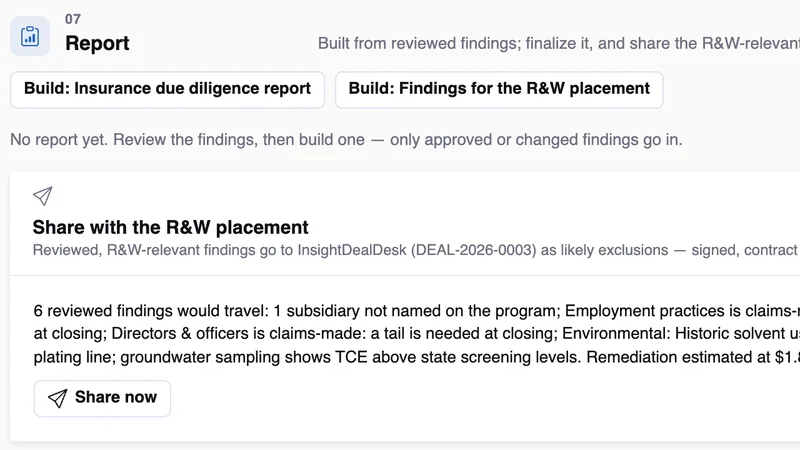
From diligence finding to R&W exclusion: the hand-off to InsightDealDesk
A reviewed finding travels, signed, and lands as a likely exclusion.