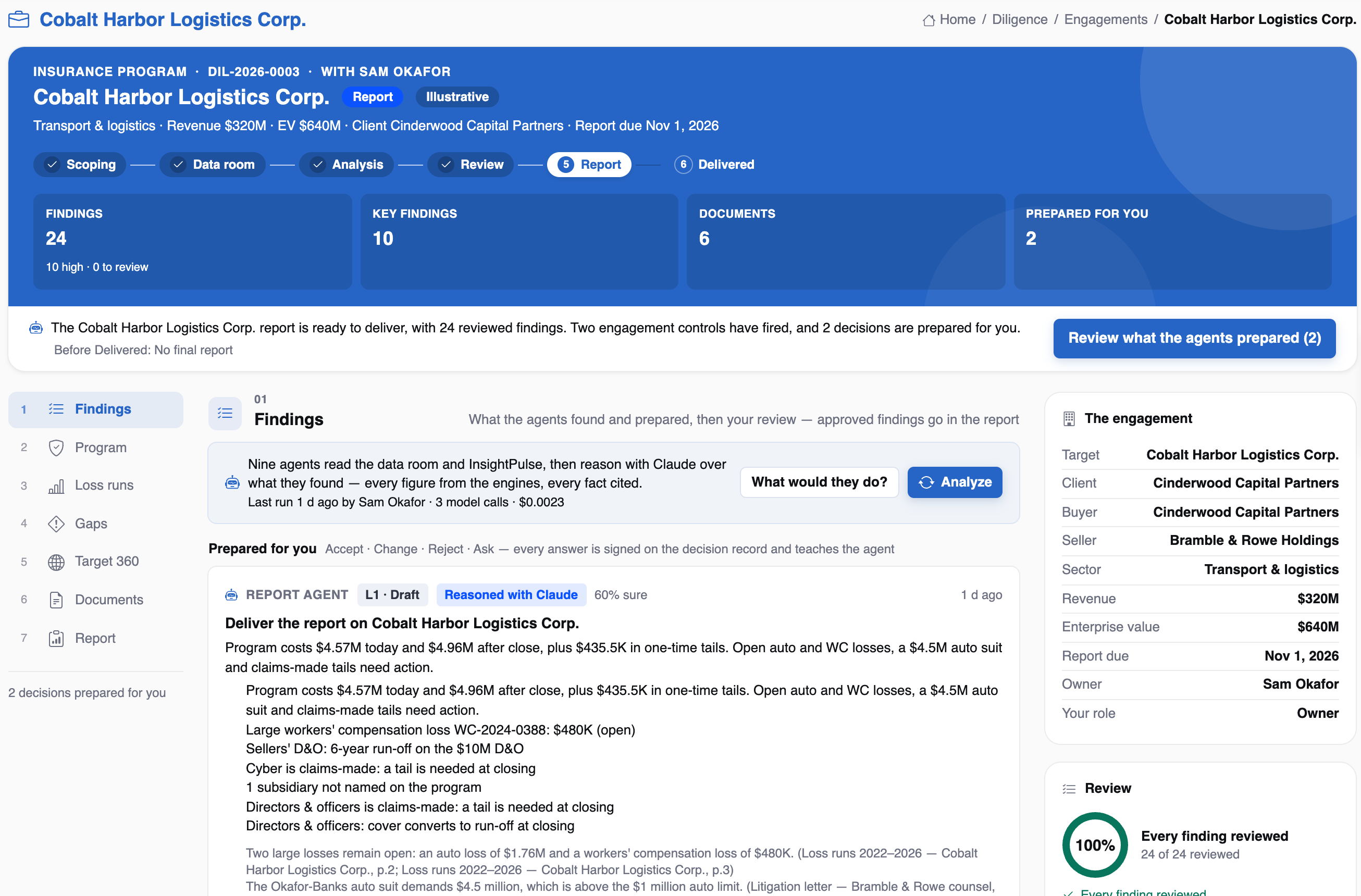
A private equity buyer is acquiring a trucking, drayage and warehousing group. Auto liability is the business’s biggest insurance cost and its biggest exposure: one open collision suit demands four and a half times the primary auto limit. Workers’ compensation runs through a captive, and letters of credit and a trust back both. This engagement is the one in the illustrative book that reaches Report. Every name and figure is illustrative.
| Engagement | Project Tideline — Cobalt Harbor Logistics Corp. (illustrative), DIL-2026-0003 |
|---|---|
| Deal | Illustrative $640M EV; revenue $320M; 2,150 employees. Buyer Cinderwood Capital Partners, seller Bramble & Rowe Holdings (illustrative) |
| Actors | Deal broker (owner), practice leader, analyst |
| Data room | Schedule of insurance, D&O, EPL and cyber declarations, loss runs 2022–2026, litigation letter |
| Agents involved | All nine; the loss run, program and report agents carry this one |
| Decisions and authority | Every finding reviewed (one changed, one rejected); the report delivered by the broker; a practice leader signs off the controls |
| Systems touched | InsightPulse; no InsightDealDesk deal linked yet, so nothing is shared |
| Outcome | 24 reviewed findings, a report built from them, and a program after closing of $4.96M against $4.57M today plus about $436K of tails |
What makes a logistics target different
$500K retention"] --> B["Open suit: $4.5M demand"] B --> C["Umbrella $25M responds
above the primary"] D["WC through a captive
fronted by a carrier"] --> E["$2M trust"] A --> F["$3.5M letter of credit;
premium financed"] E --> G["Who funds collateral
after closing?"] F --> G H["Pier Nine Drayage
in the hierarchy"] --> I["Not a named insured;
DOL classification inquiry"] style B fill:#fdecec,stroke:#e57373 style G fill:#fff4e2,stroke:#f4a03a style I fill:#fff4e2,stroke:#f4a03a
Step by step
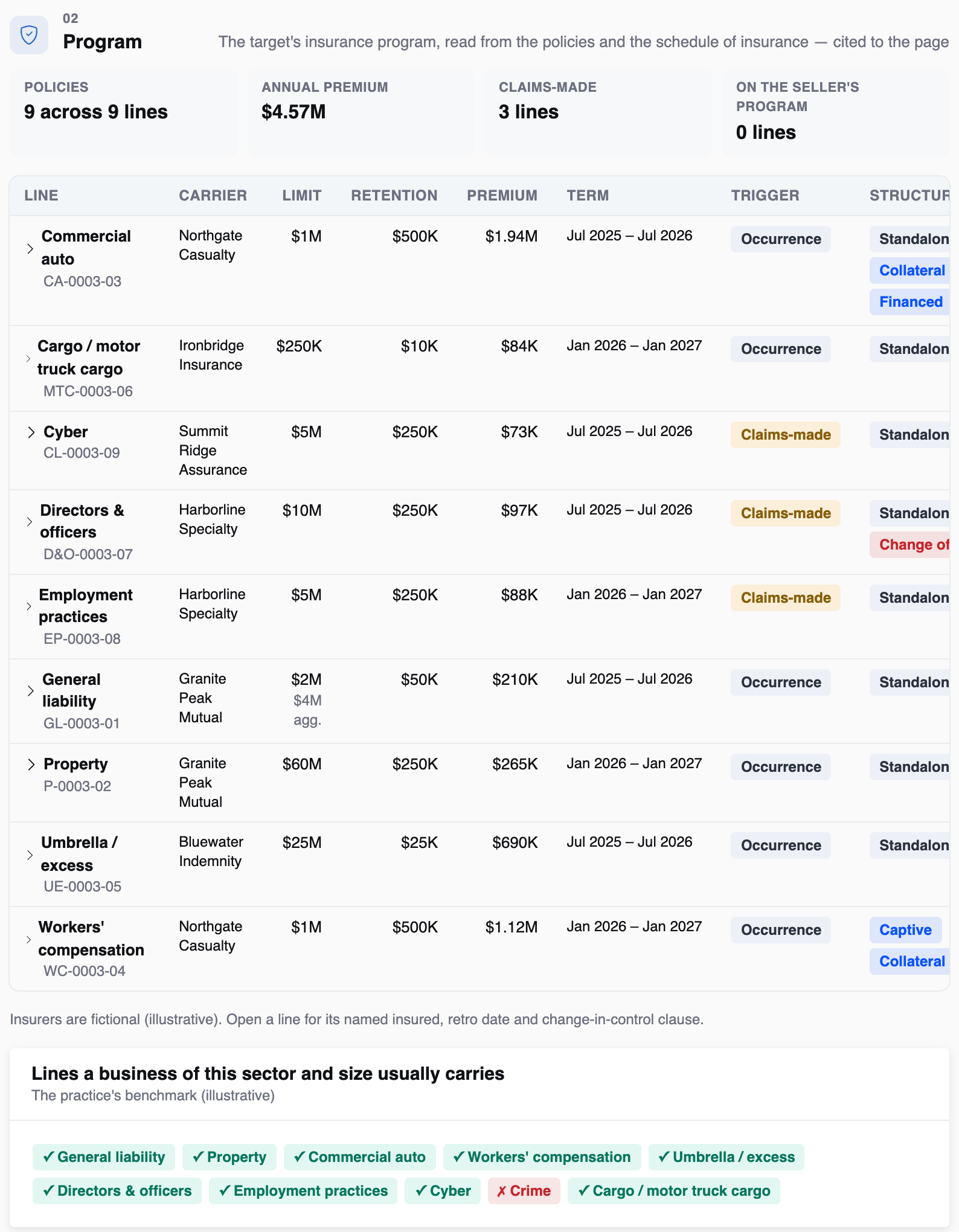
Nine lines and about $4.57M of premium. Auto carries a $500K retention, a $3.5M letter of credit and financed premium; workers’ compensation is in a captive fronted by a carrier with a $2M trust; cargo is $250K.
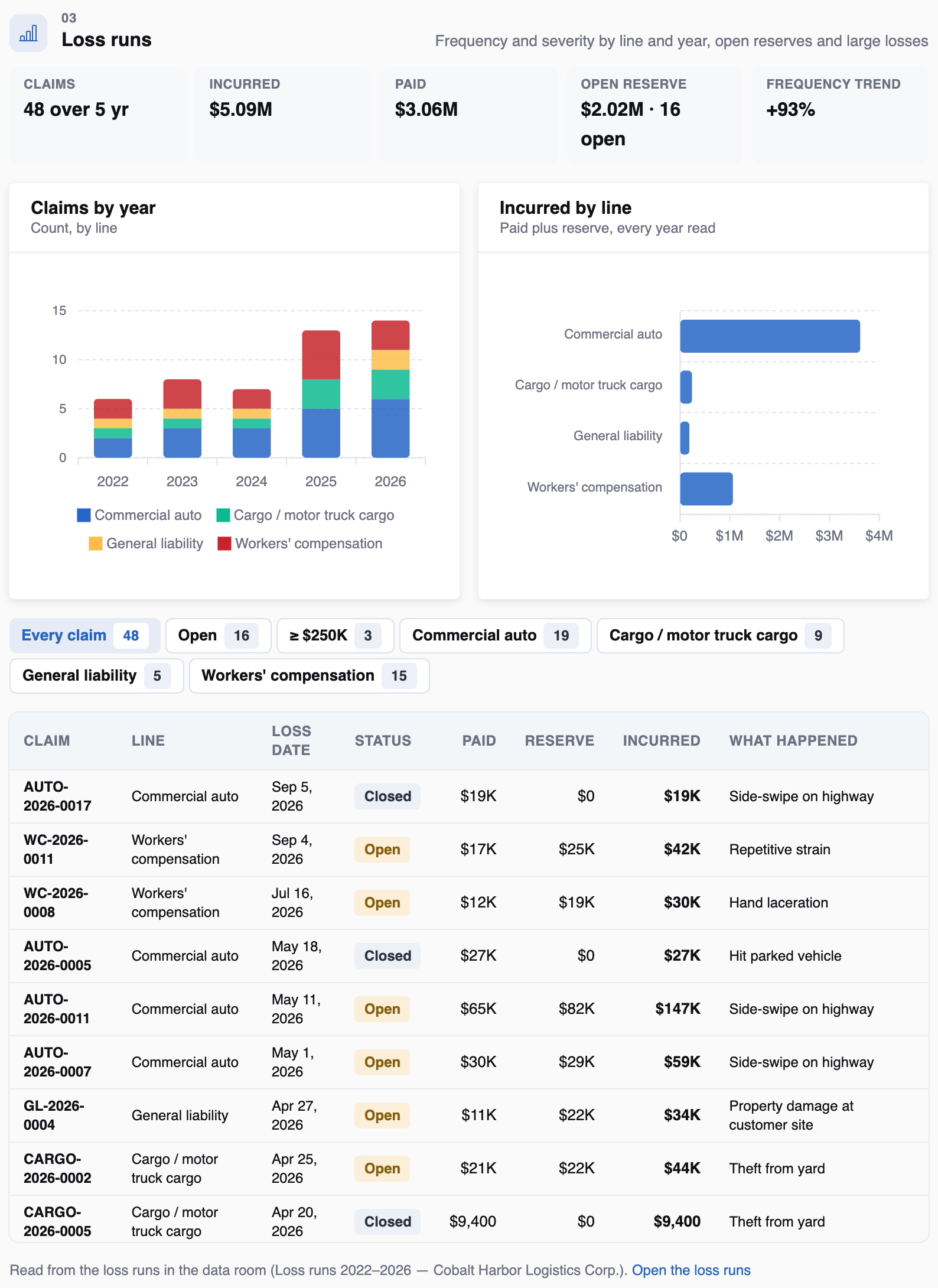
Auto and workers’ compensation frequency rising; three large losses over the threshold: an open auto collision at about $1.76M incurred, a closed ice-storm jackknife and an open forklift injury at about $480K.
The collision suit demands $4.5M, above the $1M auto limit and within the umbrella; a Department of Labor inquiry into driver classification at the drayage subsidiary.
Pier Nine Drayage Inc. is in the hierarchy; no policy names it.
No crime policy (medium); cargo $250K against an illustrative $1M benchmark.
Every finding reviewed: the crime gap approved, the cargo limit changed to low with a note that the benchmark is a guide, a background intelligence item rejected as background only.
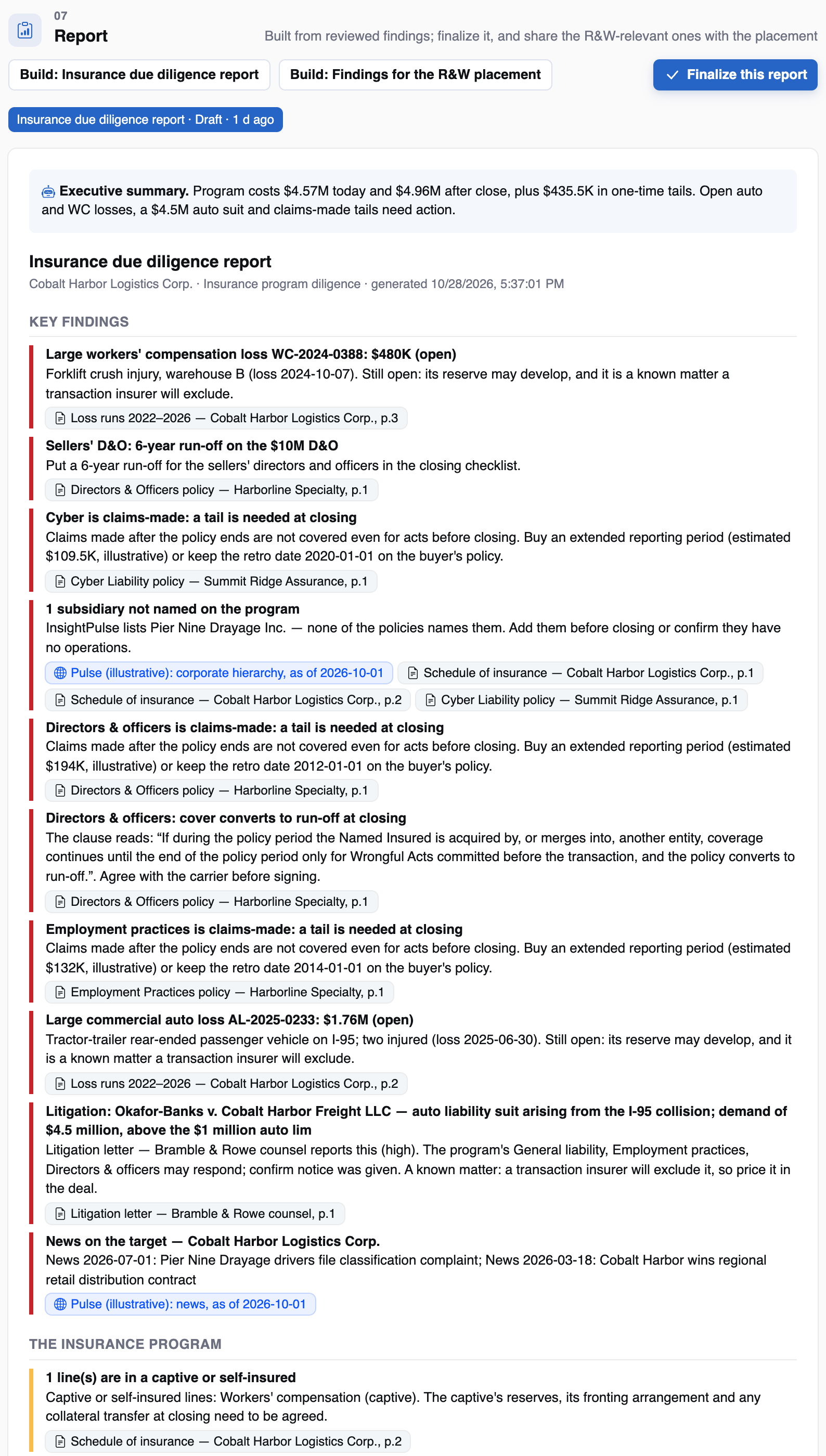
With every finding reviewed, it builds the insurance due diligence report from reviewed findings only and prepares its delivery: executive summary, key findings with citations, the program, the cost after closing.
Two controls refer: claims-made cover with no tail planned (now that a report is built) and due within a week with gaps open. It prepares the practice leader’s sign-off.
Confirms the tails are on the closing checklist and that the open gaps go out as recommendations.
Finalizes the report and accepts the prepared delivery; the engagement moves to Delivered once there is a final report and no blocking control.
The screens
The engagement’s stages
Who talks to whom at delivery
| Agent | What it prepared | What it cites | Who decides |
|---|---|---|---|
| Loss run | Large commercial auto loss AL-2025-0233: $1.76M (open) | Loss runs 2022–2026, p.2 | Broker |
| Loss run | Large workers’ compensation loss WC-2024-0388: $480K (open) | Loss runs, p.3 | Broker |
| Program | 1 line in a captive; collateral and financed premium | Schedule of insurance, p.2 | Broker |
| Contingent liability | Collision suit: $4.5M demand above the $1M auto limit | Litigation letter, p.1 | Broker |
| Report | Program $4.57M today, $4.96M after closing, about $436K of tails | Cost engine; reviewed findings | Broker delivers |
| Supervisor | Sign-off: 2 controls refer | Engagement controls | Practice leader |
Captives and collateral belong in the purchase agreement
The captive’s reserves, its fronting arrangement and any collateral transfer at closing need agreeing between buyer and seller. The finding says so and cites the schedule page, so the deal lawyers can find the facts without asking the broker.
Edge cases
| What happens | What InsightDueDiligence does |
|---|---|
| No InsightDealDesk deal is linked | Share with the R&W placement has nowhere to go; the R&W-relevant findings wait until a deal reference is set. |
| The open auto loss develops after delivery | The report is a point in time with its date; new loss runs and Analyze produce a new run and, if needed, a new report version. |
| A finding is changed after the report is built | Rebuild the report; only reviewed findings at that moment go in. |
On the deal desk
Delivery is one prepared decision after the review, not a weekend of formatting. The report’s key findings are the reviewed ones, with their pages.
For IT & architecture
The report is generated from the findings table, so it cannot contain a finding nobody reviewed. Stage moves are guarded by the same blockers the API enforces.
For practice leaders
Two controls referred and a practice leader signed; the record shows it next to the delivery.
Questions we get asked
Can the buyer get the report as a document?
The report is generated in the workspace and can be finalized and delivered. Formatting for the client is the practice’s template.
Keep reading

A senior care operator with a captive
Medical professional in a captive, a wrongful death suit and no D&O.
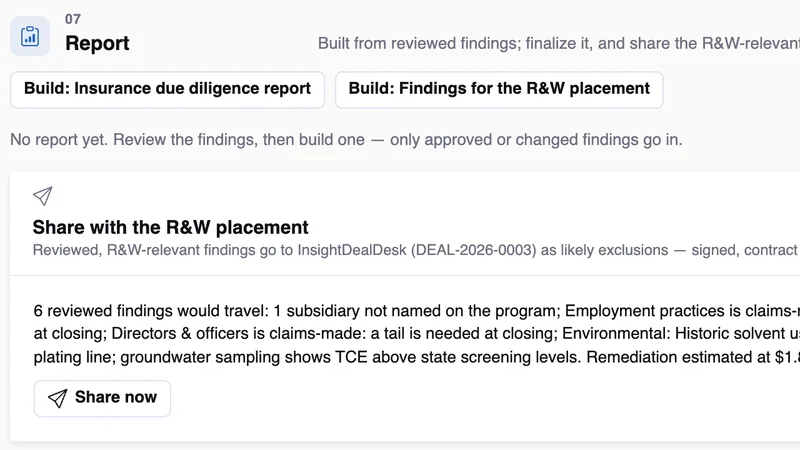
From diligence finding to R&W exclusion: the hand-off to InsightDealDesk
A reviewed finding travels, signed, and lands as a likely exclusion.