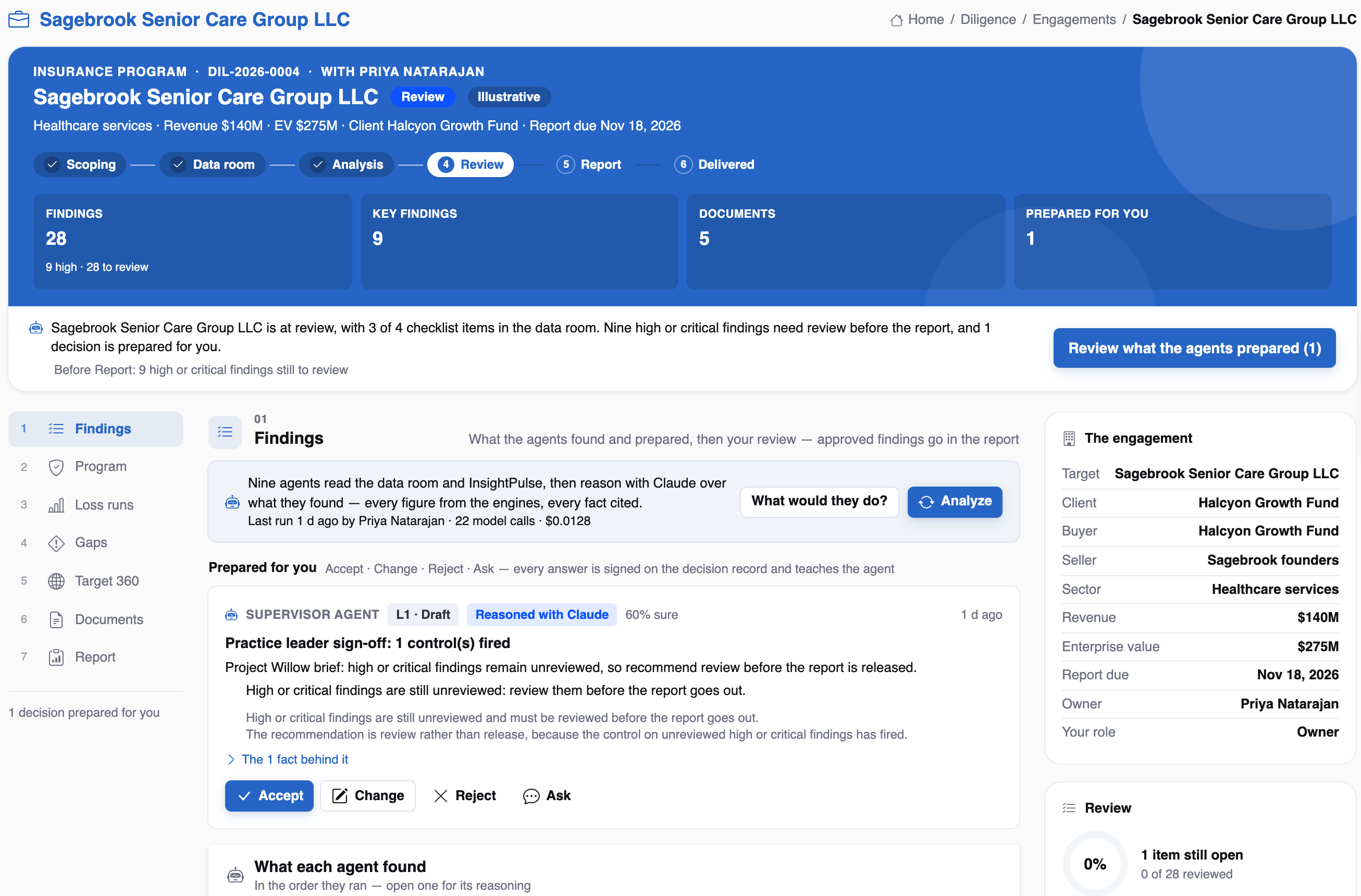
A growth fund is acquiring a senior care operator with three communities, a home health business and a pharmacy. Its largest insurance exposure — medical professional liability — is written through its own captive. Its workers’ compensation is self-insured with a surety bond. A wrongful death complaint was filed two months ago. And it carries no D&O at all. Every name and figure here is illustrative.
| Engagement | Project Willow — Sagebrook Senior Care Group LLC (illustrative), DIL-2026-0004 |
|---|---|
| Deal | Illustrative $275M EV; revenue $140M; 1,780 employees. Buyer Halcyon Growth Fund, sellers the founders (illustrative) |
| Actors | Deal broker (owner), practice leader, analyst |
| Data room | Schedule of insurance, medical professional and EPL declarations, loss runs, regulatory and litigation schedule |
| Agents involved | All nine; program, loss run, contingent liability and coverage gap carry this one |
| Decisions and authority | Broker reviews findings; the captive and the self-insured program go to the deal lawyers as purchase agreement points |
| Systems touched | InsightPulse (four operating subsidiaries, leadership, news) |
| Outcome | 28 findings, 9 high: a captive and a self-insured program to transfer, a $3.2M wrongful death demand, and D&O, cyber and crime missing against the benchmark |
The structure that has to move at closing
(illustrative)"] --> MP["Medical professional $5M
claims-made, retro 2011"] MP --> CAP["Captive
(Sagebrook Indemnity Co.)"] T --> WC["Workers' compensation"] WC --> SIR["State-approved
self-insured retention"] SIR --> BOND["$1.5M surety bond"] T --> EPL["EPL $3M claims-made"] CAP --> Q["Who owns the captive,
its reserves and tail?"] BOND --> Q2["Bond and claims
handling after closing"] style Q fill:#fff4e2,stroke:#f4a03a style Q2 fill:#fff4e2,stroke:#f4a03a
Step by step
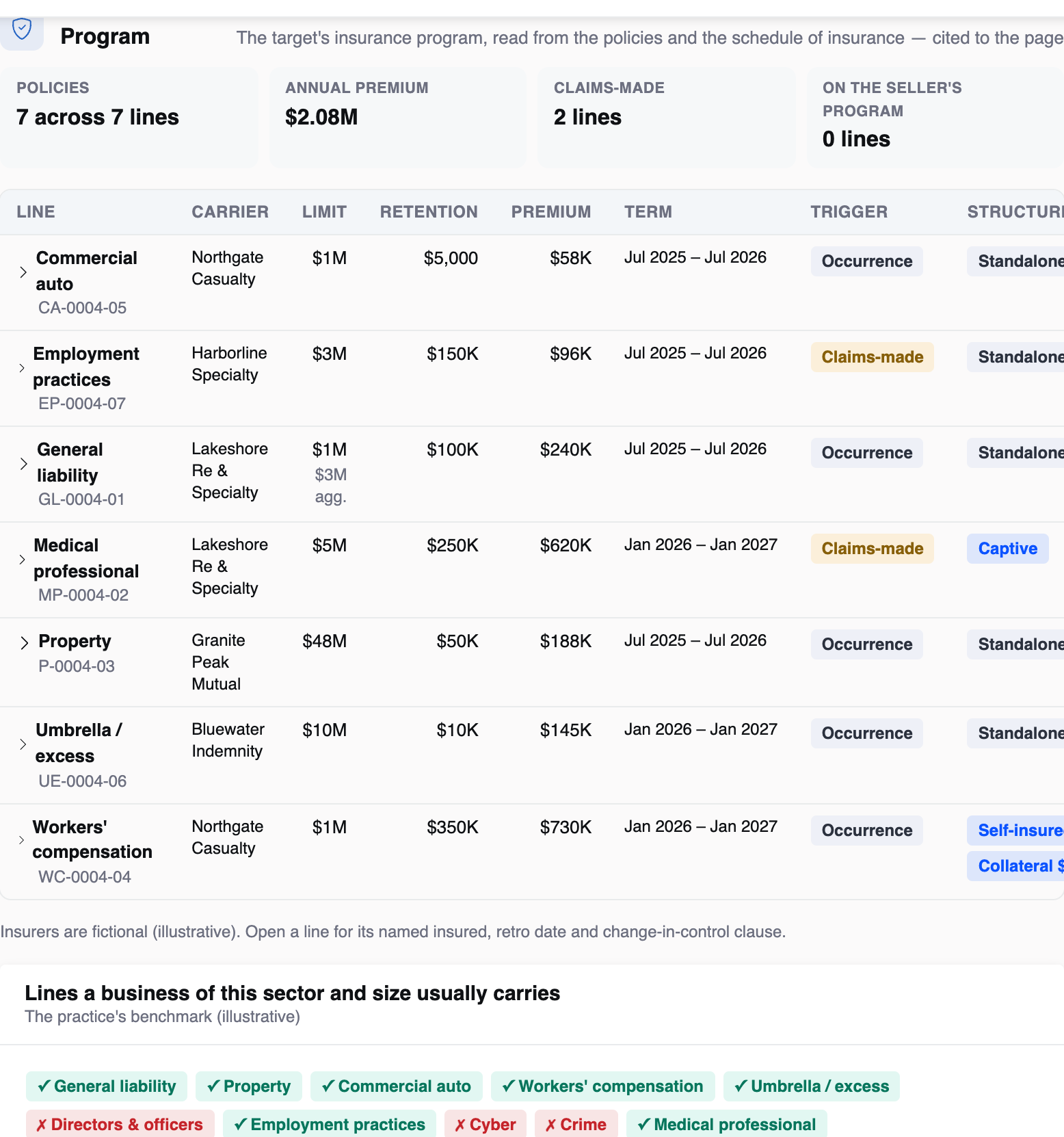
Seven lines and about $2.08M of premium; medical professional through a captive, workers’ compensation self-insured with a surety bond, two claims-made lines.
Against the illustrative benchmark for healthcare services: no D&O, no cyber, no crime.
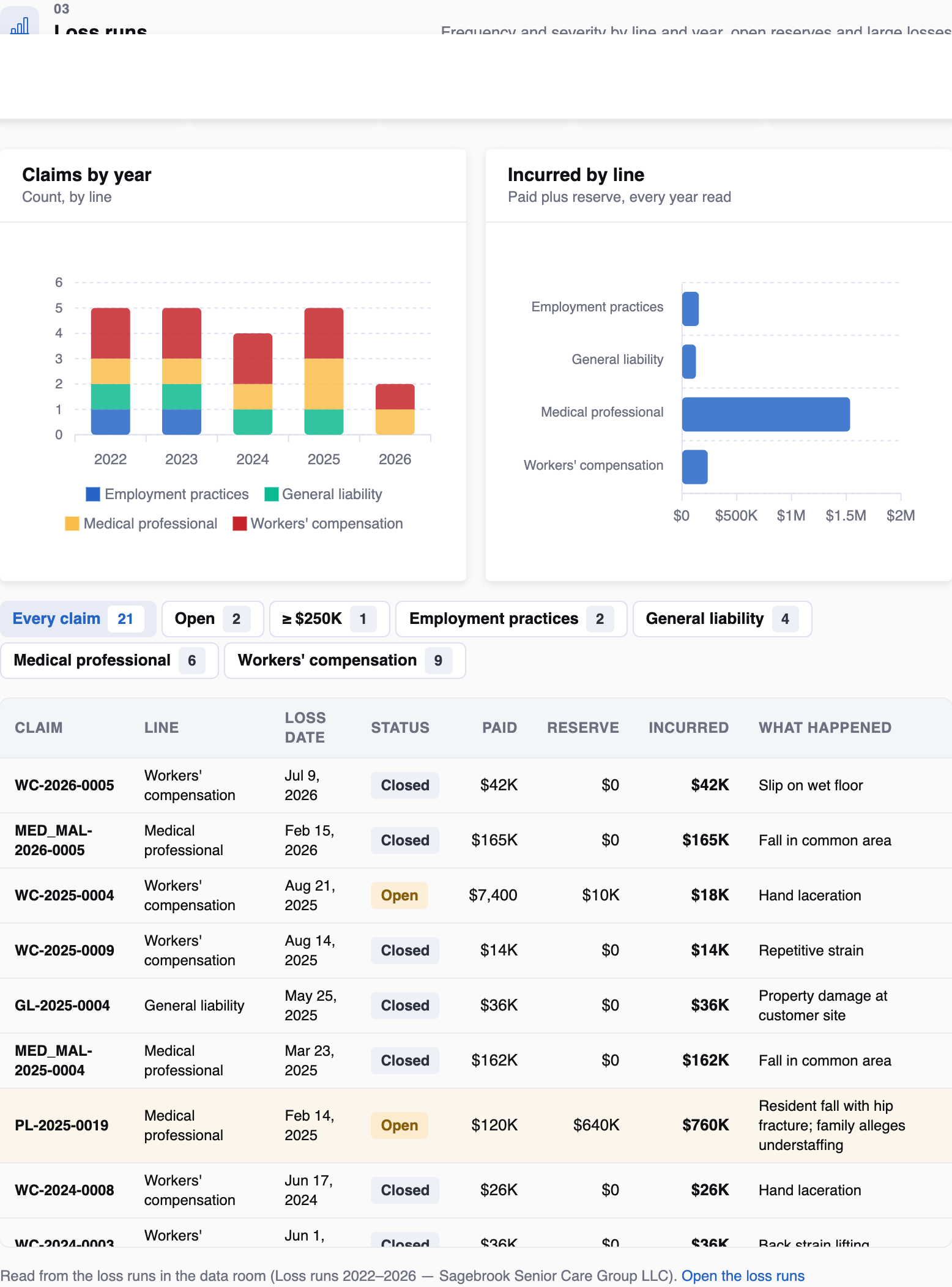
21 claims over five years, about $2.05M incurred, mostly medical professional and workers’ compensation; one large open resident-fall claim.
Three tail needs, led by the medical professional policy with a 2011 retro date; no change-of-control clauses were read.
Four operating entities in Pulse that the policies name only through blanket ‘and its subsidiaries’ wording; the finding asks the carriers to confirm.
A wrongful death complaint filed in August 2026 with a $3.2M demand, against a $5M medical professional limit; a state survey citing staffing deficiencies, with an accepted plan of correction.
Nine high findings unreviewed: the report is held and a practice leader sign-off is prepared.
Reviews the high findings, starting with the suit and the captive; adds a note that the buyer’s counsel should see the captive’s reserves and fronting before signing.
The screens
How the wrongful death suit is read
| Agent | What it prepared | What it cites | Who decides |
|---|---|---|---|
| Program | Medical professional through a captive; WC self-insured, $1.5M surety bond | Schedule of insurance | Broker |
| Coverage gap | No D&O, cyber or crime for a business of this sector and size | Schedule; practice benchmark (illustrative) | Broker |
| Contingent liability | Wrongful death complaint, $3.2M demand: a known matter | Regulatory and litigation schedule, p.1; Pulse news | Broker |
| Tail & run-off | Medical professional is claims-made: a tail is needed at closing | Medical professional declarations | Broker |
| Supervisor | Practice leader sign-off: high findings unreviewed | Engagement control | Practice leader |
No D&O is a finding, not a cost
Because the target does not carry D&O today, the program after closing does not price it. The coverage gap finding recommends buying it in the buyer’s program from closing; the placement team quotes it. The report says this in so many words, so the buyer does not read the standalone figure as complete.
Edge cases
| What happens | What InsightDueDiligence does |
|---|---|
| The captive’s financials are not in the data room | The open question goes on the seller request; the agent does not estimate reserves it has not seen. |
| A second suit appears in the news only | It is a medium finding citing Pulse, asking the seller whether it is on the litigation schedule. |
| The carrier confirms the blanket wording covers all entities | The broker changes the subsidiary finding to resolved with the note; the change is signed. |
On the deal desk
The captive, the bond and the suit are all on one page, each with the document it came from, so the call with the buyer’s counsel starts from facts.
For IT & architecture
Pulse news and the data room are cited the same way, so a reviewer can see which facts came from where.
For practice leaders
The report is held, by rule, until nine high findings are reviewed; the hold and the release are on the record.
Questions we get asked
Does it understand captives?
It recognises the structure from the schedule and flags what has to be agreed at closing. Valuing a captive is the actuaries’ job, and the finding says so.
Keep reading

A food manufacturer after an uninsured recall
$1.1 million of recall cost, no recall policy, and a subsidiary on its own GL.
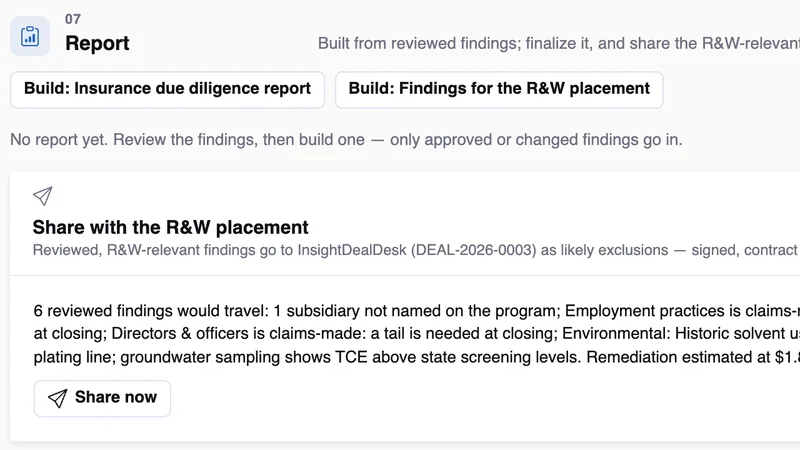
From diligence finding to R&W exclusion: the hand-off to InsightDealDesk
A reviewed finding travels, signed, and lands as a likely exclusion.