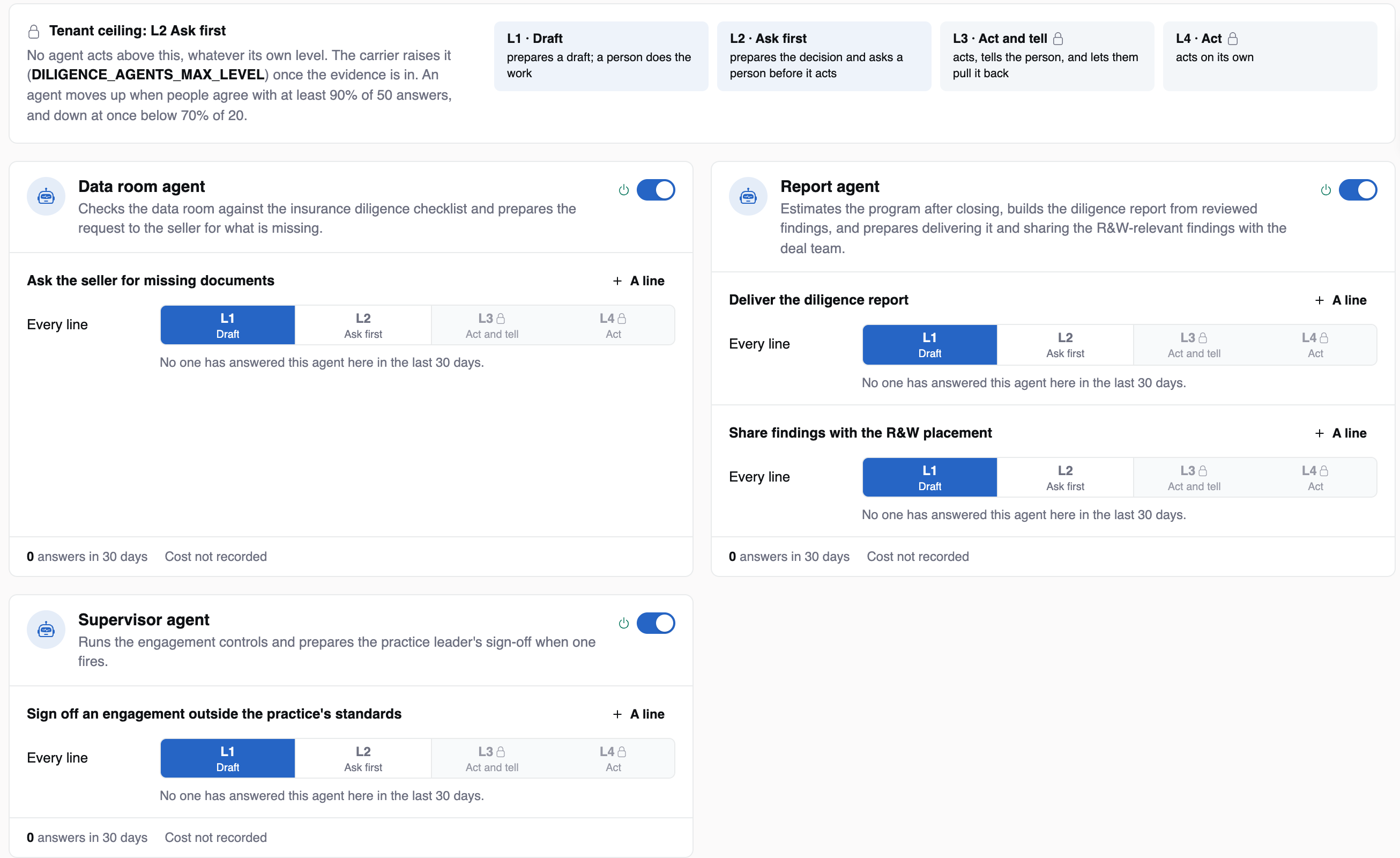
An agent that can read a data room can, in principle, also email the seller, deliver the report and send findings to the R&W team. Whether it should is a decision for the practice, per action, made on evidence. That is what the autonomy dial is for, and why every InsightDueDiligence tenant starts with the ceiling at L2, ask first.
The four levels
| Level | What the agent does |
|---|---|
| L1 · Draft | Prepares a draft; a person does the work. Where every action starts. |
| L2 · Ask first | Prepares the decision and asks a person before it acts. The default ceiling. |
| L3 · Act and tell | Acts, tells the person, and lets them pull it back. |
| L4 · Act | Acts on its own. |
The level for an action is the lowest of three: the agent’s level for that action (optionally per
sector), the action’s hard cap, and the tenant ceiling. The ceiling is set by the practice through
DILIGENCE_AGENTS_MAX_LEVEL; out of the box it is L2.
for the action"] --> MIN{"lowest of"} C["Hard cap
for the action"] --> MIN T["Tenant ceiling
(L2 by default)"] --> MIN MIN --> L["Effective level"] style T fill:#e6efff,stroke:#2563eb style L fill:#e7f8f1,stroke:#10b981,stroke-width:2px
The four governed actions, all capped
| Agent | Action | Hard cap |
|---|---|---|
| Data room agent | Ask the seller for missing documents | L2 |
| Report agent | Deliver the diligence report | L2 |
| Report agent | Share findings with the R&W placement | L2 |
| Supervisor agent | Sign off an engagement outside the practice’s standards | L2 |
Every action that leaves the product or speaks for the practice is capped at L2 whatever the dial says. Raising the ceiling does not change that; it only matters for actions a practice adds later without a cap.
How evidence moves the dial
stop here by default
Each answer to a prepared decision is feedback: accept counts as agreement, change and reject as overrides, ask as neither. An hourly roll-up recommends a promotion when people agreed with at least 90% of the last 50 answers, which a manager accepts or ignores, and demotes at once when agreement falls below 70% over 20. The autonomy page shows agreement and overrides over 30 days, per agent and per action, and a switch per agent that turns it off entirely.
What the illustrative book shows
On the demo book almost nothing has been answered yet, so every action sits at L1 with “no one has answered this agent here in the last 30 days”. That is the honest starting point for any practice: the dial starts low and moves on your own answers, not on ours.
Dry runs
“What would they do?” runs the same pipeline with nothing written: every agent works, and the screen shows what would be prepared. It is the safe way to see a new playbook or a raised level before it affects an engagement.
Questions we get asked
Can one sector be trusted more than another?
Yes. A level can be set per action and per sector, so a practice could let the data room agent draft seller requests for software targets at a different level from healthcare.
Who can change the ceiling?
It is deployment configuration, not a screen setting, so it changes through the practice’s own change process.

