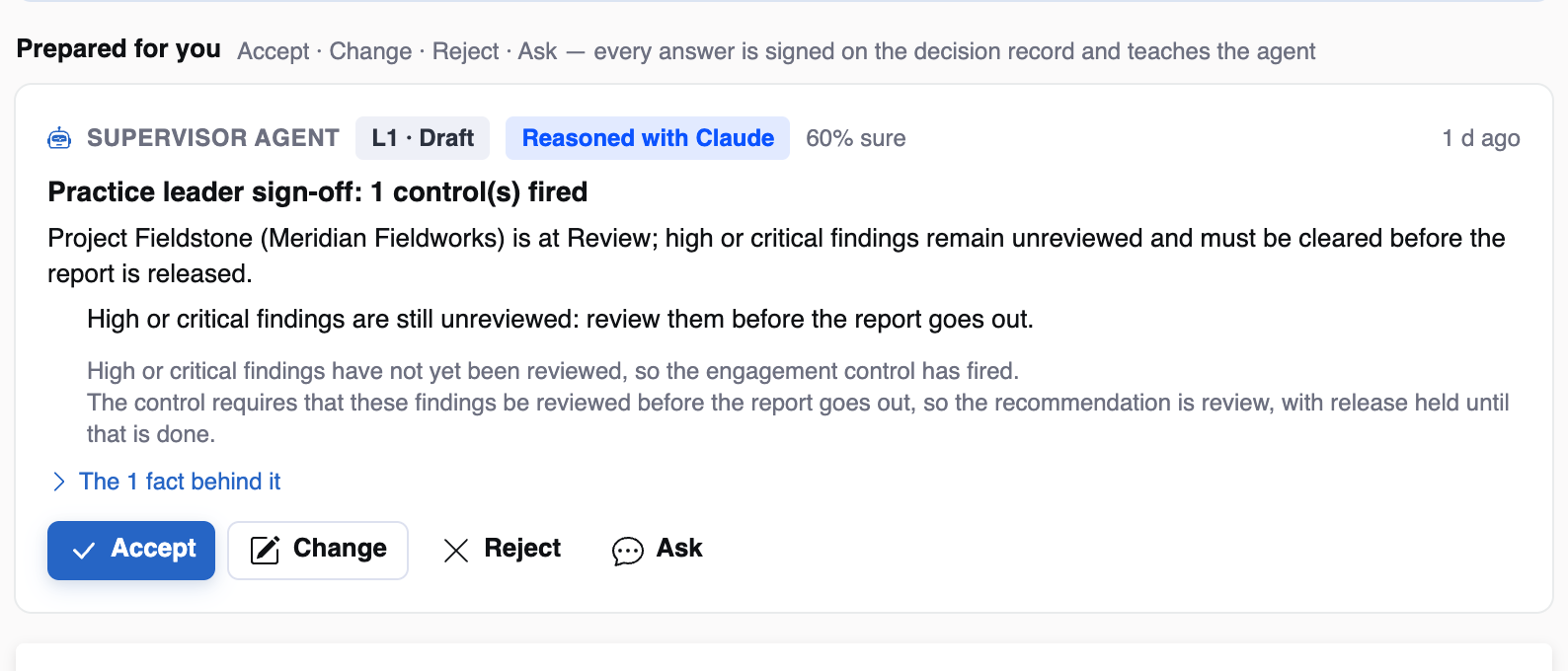
A buyer relies on an insurance diligence report when it prices a deal and negotiates the purchase agreement. If a finding later turns out to matter, the practice will be asked a simple question: who decided this, on what, and when? The decision record is InsightDueDiligence’s answer, kept for every engagement from the first Analyze to the delivered report.
What gets written, and when
| Event | What the record keeps |
|---|---|
| Analyze (the supervisor step) | A run of the engagement controls: each hit with its rule, the facts it read and its outcome, and the verdict. Earlier runs are kept; the newest is marked current. |
| A finding reviewed | Approved, changed (with what changed, for example severity high to low) or rejected, by whom, with the note. |
| A prepared decision answered | Accept, change, reject or ask, the effect that was carried out, and a sign-off by the person who answered. |
| A practice leader’s sign-off | A second, human sign-off on the control run it covers. |
| A stage move | From and to, by whom; moving back a stage needs a reason. |
| Sharing with the deal | The hand-off to InsightDealDesk: how many findings, its event id and whether it was sent or held. |
The verdict is a ranking
a control blocks"] --> R["refer
a practice leader decides"] --> N["needs_info
something missing"] --> P["proceed"] style H fill:#fdecec,stroke:#e57373 style R fill:#e6efff,stroke:#2563eb style P fill:#e7f8f1,stroke:#10b981
The highest-ranked outcome among the hits wins. On an engagement, a block — high or
critical findings still unreviewed — holds the report; a refer — claims-made
cover with no tail planned, or a report due within a week with gaps open — sends it to a
practice leader; a warn, such as loss runs shorter than five years, is recorded and
shown but does not stop anything. Agents never set the verdict; the controls do.
One engagement’s record
An illustrative example of the record a software target at review builds up: the control run from Analyze, then a few answers. The answers are invented for this post.
| Section | Hit | Outcome |
|---|---|---|
| Engagement control | High or critical findings not reviewed: 9 high findings pending | hold |
| Engagement control | Fewer than five years of loss runs: 3 years read | warn |
| Finding review | Cyber policy ends at closing: approved by the deal broker | pass |
| Finding review | Subsidiaries not named: changed to low (blanket ‘and its subsidiaries’ wording) | pass |
| Prepared decision | Ask the seller for two missing items: rejected, the request had already gone by email | decline |
| Practice leader | Sign-off on the control run: pending | refer |
How the record is made
Who can sign what
The person who answers is the person recorded. A practice leader’s sign-off can only be accepted by a practice leader or compliance; a deal broker who tries is refused, and the refusal is not a decision. Agents act as themselves with their own identity, so the record can always tell an agent’s step from a person’s answer.
Why keep rejected and superseded answers?
A prepared decision that was rejected, or that a later run superseded, says something about the agent and about the engagement. Rejections are evidence for the autonomy dial; superseded asks show how the engagement moved. Nothing is deleted.
Questions we get asked
Can a report go out with a control firing?
A blocking control holds the move to Delivered. A referring control needs the practice leader’s sign-off, which is itself recorded.
Is the record shared with InsightDealDesk?
No. What travels to InsightDealDesk is the reviewed findings under a signed contract. Each product keeps its own record of what it decided.

