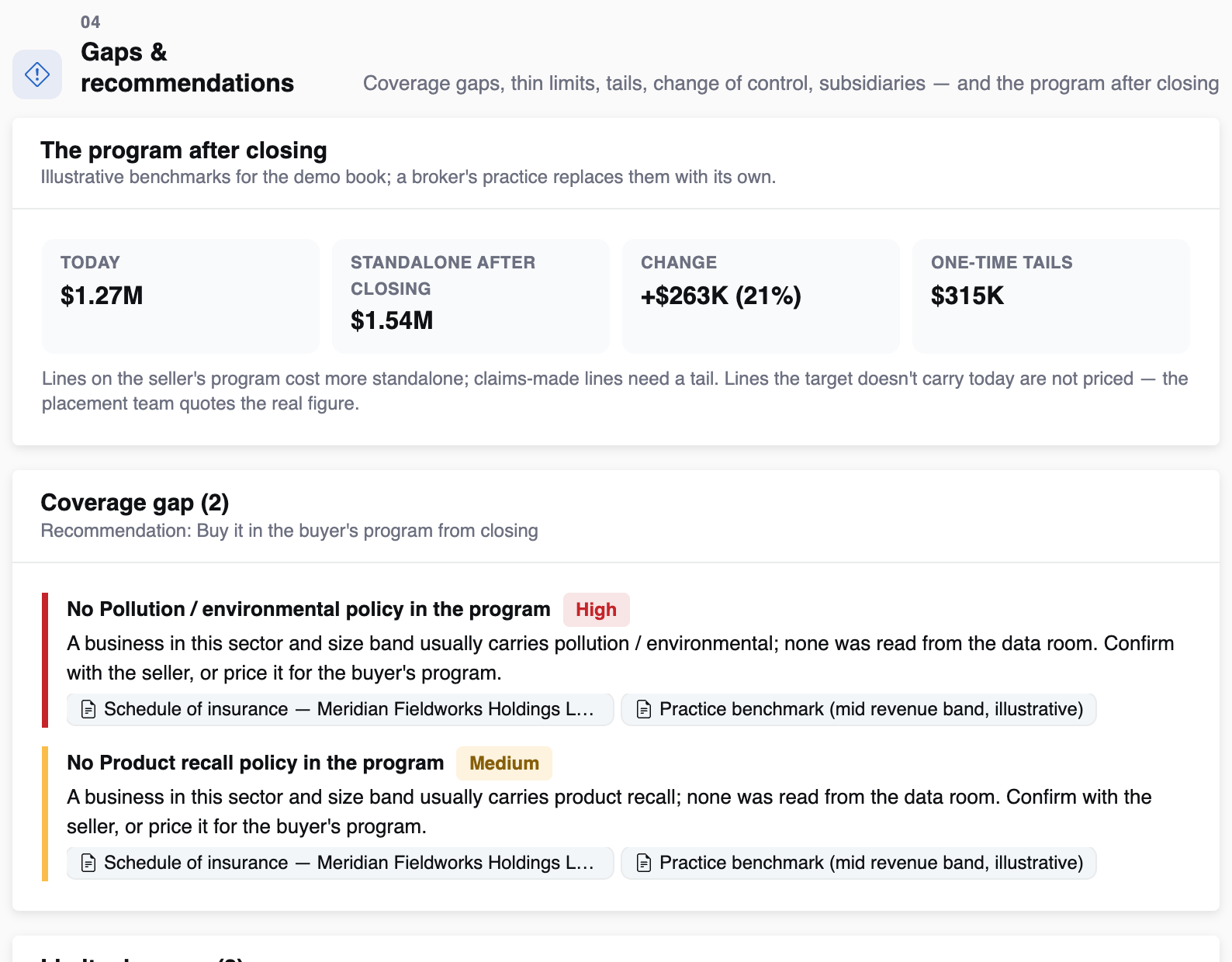
A target that has lived on its parent’s master program pays for its insurance at the parent’s scale. The day after closing it buys alone, and it may also have to buy tails on every claims-made policy. Buyers who model the deal on today’s premium are modelling the wrong number. The report agent estimates the right one, from the practice’s own assumptions.
The calculation
line, premium, structure,
trigger"] --> U["Uplift by structure
(practice benchmark)"] P --> T{"Claims-made?"} T -- yes --> TC["Tail = premium x
the line's multiple"] T -- no --> Z["No tail"] U --> S["Standalone premium
after closing"] S --> SUM["Today vs after,
change and change %"] TC --> TT["One-time tails"] style U fill:#e6efff,stroke:#2563eb style TC fill:#e6efff,stroke:#2563eb style SUM fill:#e7f8f1,stroke:#10b981
The engine applies two tables from the pack’s benchmarks. The values below are the illustrative ones that ship with the demo book; a practice replaces them with its own experience:
| Program structure today | Illustrative uplift standalone |
|---|---|
| On the seller’s (parent’s) master program | +35% |
| Captive | +20% |
| Standalone already | +5% |
| Self-insured | 0% (not priced; the funding stays the buyer’s problem) |
| Claims-made line | Illustrative tail multiple of annual premium |
|---|---|
| Directors & officers, medical professional | 2.0× |
| Errors & omissions | 1.75× |
| Cyber, employment practices, fiduciary, pollution | 1.5× |
On three illustrative targets
| Target (illustrative) | Today | Standalone after closing | Change | One-time tails |
|---|---|---|---|---|
| Industrial, four lines on the parent’s program | $1.27M | $1.54M | +$263K (21%) | $315K |
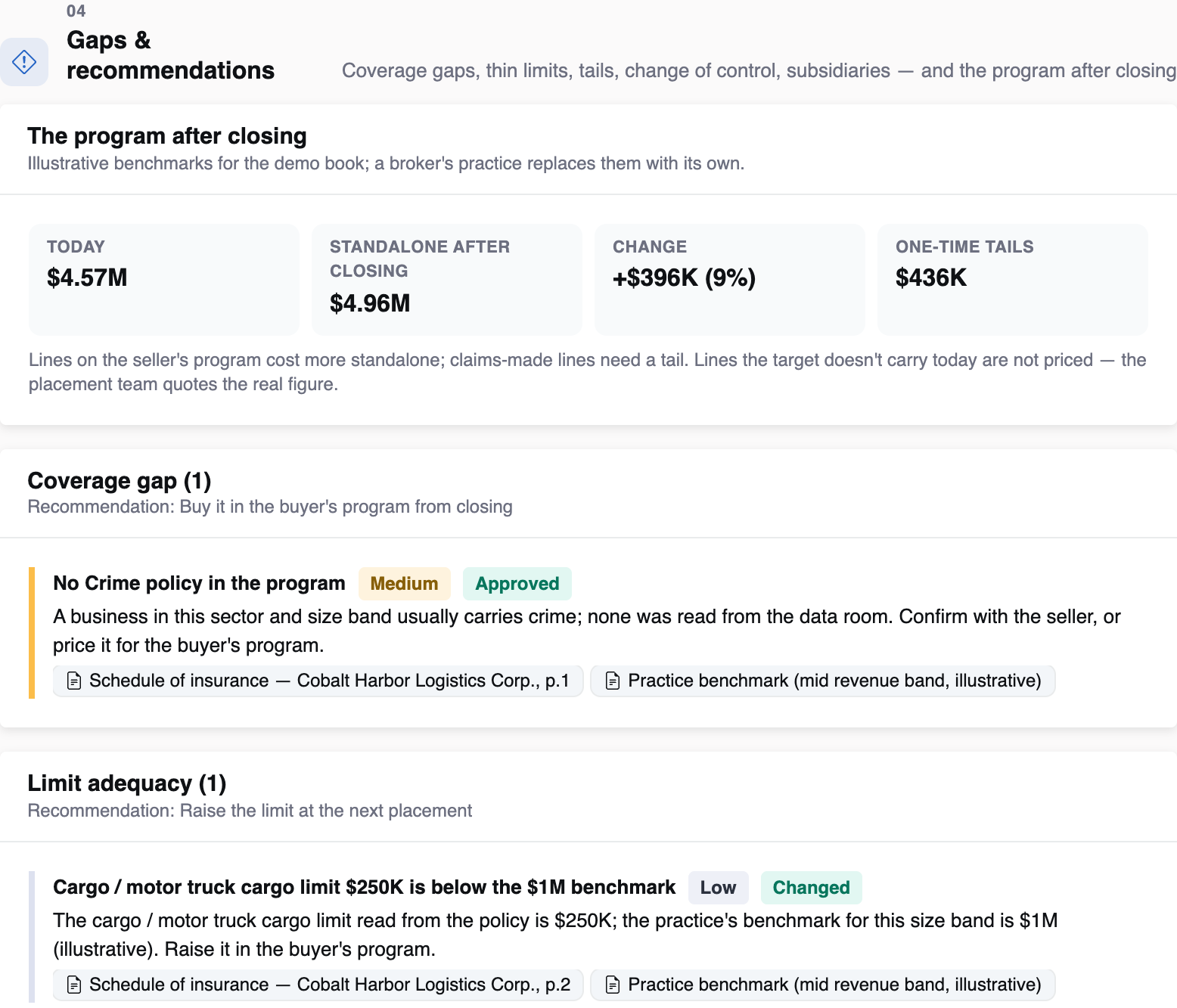
| Logistics, workers’ compensation in a captive | $4.57M | $4.96M | +$396K (9%) | $436K |
| Software, mostly standalone | $310K | $326K | +$16K (5%) | $405K |
The software target is the instructive one: its premium barely moves, but its tails cost more than a year of its whole program, because four of its lines are claims-made. A buyer looking only at the annual premium would miss the largest closing cost.
What it does not price
Lines the target does not carry today are not priced. A missing pollution or product recall policy is a coverage gap finding with a recommendation to buy it in the buyer’s program; the placement team quotes the real figure. The screen says so under the numbers, so nobody mistakes the estimate for a quote.
An estimate, labelled as one
Every cost figure on screen and in the report carries “illustrative” while the practice is on the shipped benchmarks. When a practice loads its own, the label is the practice’s note on its assumptions. The model never changes the figure.
Questions we get asked
Why not ask the model for a market estimate?
Because it would be a number the documents do not support and the practice did not set. A practice’s own uplift and tail tables are auditable; a model’s guess is not.
Does the estimate go to InsightDealDesk?
No. The hand-off carries R&W-relevant findings. The cost after closing is for the buyer’s model and the buyer’s own program.

